Showing posts with label gut bacteria. Show all posts

Sunday, 18 October 2015

A healthy gut is the hidden key to weight loss

In a previous article in this series on diabesity I briefly mentioned the role of gut health in obesity and diabetes. I’d like to go into more detail on that subject here, especially since it’s not a very well known relationship.
Our gut is home to approximately 100,000,000,000,000 (100 trillion) microorganisms. That’s such a big number our human brains can’t really comprehend it. One trillion dollar bills laid end-to-end would stretch from the earth to the sun – and back – with a lot of miles to spare. Do that 100 times and you start to get at least a vague idea of how much 100 trillion is.
The human gut contains 10 times more bacteria than all the human cells in the entire body, with over 400 known diverse bacterial species. In fact, you could say that we’re more bacterial than we are human. Think about that one for a minute.
We’ve only recently begun to understand the extent of the gut flora’s role in human health and disease. Among other things, the gut flora promotes normal gastrointestinal function, provides protection from infection, regulates metabolism and comprises more than 75% of our immune system. Dysregulated gut flora has been linked to diseases ranging from autism and depression to autoimmune conditions like Hashimoto’s, inflammatory bowel disease and type 1 diabetes.
Recent research has shown that the gut flora, and the health of the gut in general, also play a significant role in both obesity and diabetes. I’ve seen this anecdotally in my practice as well. Nearly every patient I treat with a blood sugar issue also has a leaky gut, a gut infection, or some other chronic inflammatory gut condition.
We now know that the composition of the organisms living in your gut determines – to some extent, at least – how your body stores the food you eat, how easy (or hard) it is for you to lose weight, and how well your metabolism functions. Let’s take a closer look at the mechanisms involved.

Intestinal bacteria drive obesity and metabolic disease

A study published this year in Science magazine found that mice without a protein known as toll-like receptor 5 (TLR5) in their gut gain excessive weight and develop full-blown diabetes and fatty liver disease when fed a high-fat diet. If we think of the gut flora as a community, TLR5 is like a neighborhood police force that can keep the houligans in check. Without TLR5, bad bacteria can get out of control.
The study authors found that these bad bacteria caused a low-grade inflammation in the mice, which caused them to eat more and develop insulin resistance. They also found that treating these mice with strong antibiotics (enough to kill most of the bacteria in the gut) reduced their metabolic abnormalities.
But the most interesting part of this study is what happened when the researchers transferred the gut flora from the TLR5-deficient overweight mice into the guts of skinny mice: the skinny mice immediately started eating more and eventually developed the same metabolic abnormalities the overweight mice had. In other words, obesity and diabetes were “transferred” from one group of mice to the other simply by changing their gut flora.
Other studies have shown that the composition of the gut flora differs in people who are obese and diabetic, and people who are normal weight with no metabolic irregularities.
One possible mechanism for how changes in the gut flora cause diabesity is that different species of bacteria seem to have different effects on appetite and metabolism. In the study on TLR5 deficient mice I mentioned above, the mice with too much bad bacteria in their guts experienced an increase in appetite and ate about 10 percent more food than their regular relatives. But it wasn’t just that these mice were hungrier and eating more; their metabolisms were damaged. When their food was restricted, they lost weight – but still had insulin resistance.
Other studies have shown that changes in the gut flora can increase the rate at which we absorb fatty acids and carbohydrates, and increase the storage of calories as fat. This means that someone with bad gut flora could eat the same amount of food as someone with a healthy gut, but extract more calories from it and gain more weight.
Bad bugs in the gut can even directly contribute to the metabolic syndrome by increasing the production of insulin (leading to insulin resistance), and by causing inflammation of the hypothalamus (leading to leptin resistance).

How modern life screws up our gut and makes us fat and diabetic

What all of this research suggests is that healthy gut bacteria is crucial to maintaining normal weight and metabolism. Unfortunately, several features of the modern lifestyle directly contribute to unhealthy gut flora:
  • Antibiotics and other medications like birth control and NSAIDs
  • Diets high in refined carbohydrates, sugar and processed foods
  • Diets low in fermentable fibers
  • Dietary toxins like wheat and industrial seed oils that cause leaky gut
  • Chronic stress
  • Chronic infections
We also know that infants that aren’t breast-fed and are born to mothers with bad gut flora are more likely to develop unhealthy gut bacteria, and that these early differences in gut flora may predict overweight and obesity in the future.
It’s interesting to note that the diabesity epidemic has neatly coincided with the increasing prevalence of factors that disrupt the gut flora. I’m not suggesting that poor gut health is the single cause of obesity and diabetes, but I am suggesting that it likely plays a much larger role than most people think.

How to maintain and restore healthy gut flora

The most obvious first step in maintaining a healthy gut is to avoid all of the things I listed above. But of course that’s not always possible, especially in the case of chronic stress and infections, and whether we were breast-fed or our mothers had healthy guts.
If you’ve been exposed to some of these factors, there are still steps you can take to restore your gut flora:


Source
http://chriskresser.com/a-healthy-gut-is-the-hidden-key-to-weight-loss/

Saturday, 12 September 2015

Fiber Can Help You Lose Weight, But Only A Specific Type

Fiber is a well known nutrient, but not well understood.
Put simply, fiber refers to carbohydrates that cannot be digested by humans.
They are classified as either soluble or insoluble, depending on whether they dissolve in liquids.
Insoluble fibers function mostly as “bulking” agents and are not very interesting.
However… soluble fiber can have powerful effects on health and metabolism (1).
Several studies show that soluble fiber can help you lose fat… but this fiber must have certain properties.
Let me explain…

Fiber Feeds The Friendly Bacteria in The Gut

It is estimated that around 100 trillion bacteria live in the human gut, primarily in the large intestine (2).
These bacteria are known as the gut flora.
Having bacteria in the gut may sound undesirable, but this is actually a good thing.
Different types (species) of bacteria play important roles in various aspects of health, including weight management, blood sugar control, immunity and even brain function (34567).
Just like other organisms, bacteria need to eat well to stay healthy.
This is where fiber (mostly soluble) steps in… it passes through the digestive system mostly unchanged, eventually reaching the friendly bacteria in the intestine who end up digesting the fiber and turning it into usable energy.
Nourishing the friendly bacteria in the intestine is known as a prebiotic effect, and is believed to be very beneficial for health and body weight (89).
Another type of fiber called resistant starch behaves in a similar manner.
Bottom Line: Fiber does not get digested and tends to reach the large intestine relatively unchanged. There, certain soluble fibers can help feed the friendly bacteria that are absolutely essential for good health.

The Good Bacteria Help Fight Inflammation, a Key Driver of Obesity and Disease


Gut bacteria have long been known to have an effect on inflammatory pathways (10).
They produce nutrients for the body, including short-chain fatty acids that feed the cells in the colon.
This leads to reduced gut inflammation and improvements in related inflammatory disorders (111213).
Just to clarify, acute (short-term) inflammation is beneficial as it helps the body fight foreign invaders and repair damaged cells.
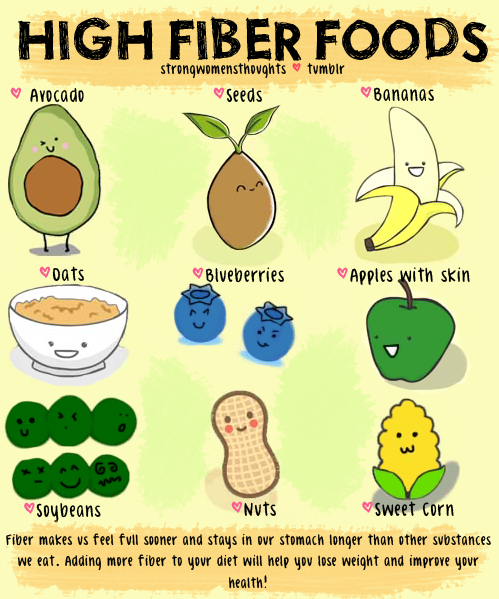
High fibre bran cereal with ground flaxseed, sliced banana, red grapes, strawberries, blueberries, blackberries, sunflower seeds, pumpkin seeds and almond milk.
However, chronic (long-term) inflammation becomes a major problem when it is inappropriately deployed against the body’s own tissues.
We now know that chronic, low-level inflammation plays a major role in almost everychronic Western disease, including heart disease, Alzheimer’s and metabolic syndrome, to name a few (141516).
There is also mounting evidence that inflammation is a strong driver of weight gain and obesity, possibly mediated via its effects on the hormone leptin (171810).
Several observational studies have shown that a high fiber intake is linked to lower levels of inflammatory markers in the bloodstream (1920).
Bottom Line: Inflammation is a strong driver of disease, including obesity. Fiber consumption has been linked to reduced inflammation..

Viscous Fiber May Reduce Your Appetite, Helping You Eat Less Without Trying

While I don’t believe that counting calories is necessary, it is a simple fact that we need to be in calorie deficit to lose weight.
That is, more calories (energy) need to be leaving the body than entering it.
Anything that reduces our appetite can make us take in fewer calories without having to think about it.
Fiber is often believed to have this effect… that is, making us feel more satiated so that we eat less.
However, according to the evidence, only a specific type of fiber does this.
A recent review of 44 studies found that while 39% of fiber treatments increased satiety, only 22% actually reduced food intake (21).
If we break it down further, it seems that the more viscous a fiber is, the better it is at reducing appetite and food intake.
Put simply, the viscosity of a substance refers to its resistance to stress – as in, the “thickness” of a liquid. For example, honey is much more viscous than water.
Viscous soluble fibers such as pectins, β-glucans, psyllium, glucomannan and guar gum all thicken in water, forming a gel-like substance that “sits” in the gut (22).
This gel slows down the emptying of the stomach and increases the time it takes to digest and absorb nutrients. The end result is a prolonged feeling of fullness and a significantly reduced appetite (2324).
There is some evidence that the weight loss effects of fiber target the belly fatspecifically, which is the harmful fat in the abdominal cavity that is strongly associated with metabolic disease (25).
Bottom Line: Fibers with a high viscosity have been shown to increase satiety, reduce appetite and cause automatic weight loss. Fibers with low viscosity appear to have no influence.

Are Fiber Supplements Effective for Weight Loss?


Fiber supplements are typically made by isolating the fiber from plants.
While these isolated fibers may have some health benefits, the evidence for weight control is mixed and pretty unconvincing.
A very large review study found that psyllium and guar gum (both soluble, viscous fibers) are ineffective as weight loss supplements (26).
One notable exception is glucomannan, a fiber extracted from the konjac root.
This is one of the most viscous dietary fibers known, and has been shown to cause modest weight loss when used as a supplement (272829).
But in the real world, it’s the synergy of all the nutrients in foods that provides the most benefits, consuming isolated nutrients will never have the same effects.
For this reason, getting your fiber from whole plant foods is best.
Bottom Line: Fiber supplements are mostly ineffective for weight loss, with the exception of a powerful type of fiber called glucomannan. Getting your fiber from whole plant foods is the best and healthiest approach.

Rich Sources of Viscous Fiber


Viscous fibers are found exclusively in plant foods.
Rich sources include beans (legumes), flax seeds, asparagus, brussels sprouts and oats, to name a few.
If you’re planning to switch to a high-fiber diet, remember to do it gradually to give your body time to adjust.
Abdominal discomfort, cramps and even diarrhea are common side effects if you ramp up your fiber intake too quickly.

Take Home Message

Adding more foods rich in fiber (especially viscous fiber) can be an effective way to lose weight.
But, same as with any other weight loss method, it won’t lead to long term results unless it comes with a lasting lifestyle change.
Also, let’s not forget that health is about way more than just weight. Eating plenty of fiber from real foods can have numerous other health benefits.


Source
http://authoritynutrition.com/fiber-can-help-you-lose-weight/

Thursday, 10 September 2015

How to choose a healthy yoghurt

Are you eating a health food or a "dairy dessert"? How to 
pick the healthiest yoghurts from the nutrition traps.


Healthy yoghurt or nutrition trap?

Yoghurt (also spelled "yogurt") is often marketed as a healthy, calcium-rich product. Yet some of the products in the supermarket fridge are closer to a "dairy-based dessert" than a health food. CHOICE decided to look behind the hype and find out how to pick the nutritious yoghurts from the products that should ring alarm bells.
At its simplest, yoghurt contains milk and live cultures (bacteria) that cause the milk to ferment, creating the distinctive sour taste. But modern commercial yoghurts tend to have extra ingredients such as sugar, cream, thickeners, gums, starches and flavours.

Low- or no-fat natural yoghurt: your healthiest option

"The healthiest yoghurt choice is low- or no-fat plain yoghurt," says Kate Gudorf, an accredited practising dietitian and spokesperson for the Dietitians Association of Australia. "But if you need to sweeten it yourself, add a teaspoon of honey or chopped fresh fruit."
If you're buying flavoured yoghurt, Gudorf recommends trying to find one with less than 12g of sugars per 100g. Natural or plain yoghurt has around 6mg of sugars per 100g due to the naturally occurring carbohydrate lactose. Anything above 6mg will be added sugar, generally in the form of fruit pieces, fruit puree, honey and sugar.
And if you're in the mood for a treat, sweetened low-fat yoghurts will generally be a better choice than a chocolate bar as they have lower saturated fat (0.2g vs 18.8g/100g) and far less sugar (12.6g vs 56.4g/100g).

Beware breakfast yoghurts

Bulla Yoghurt Crunch Summer Berry
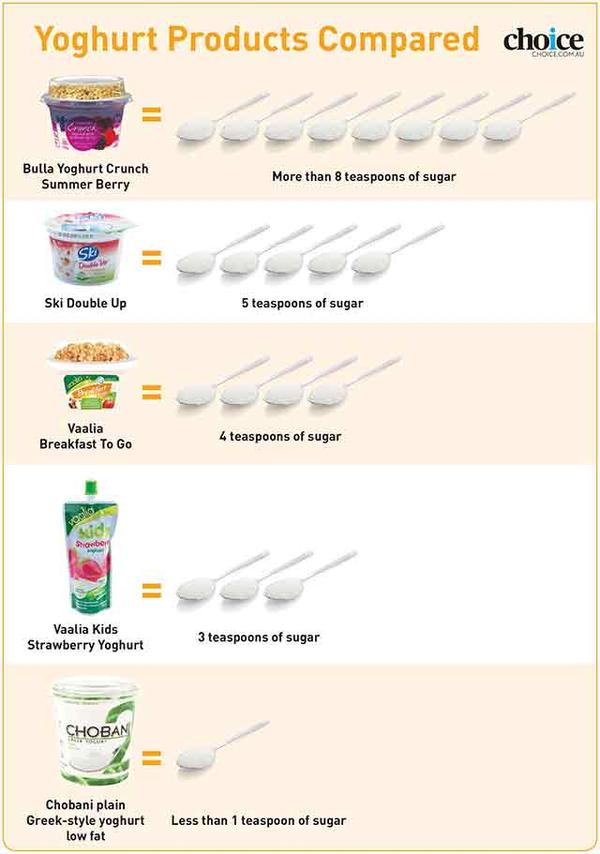
Packaged breakfast yoghurt pots with muesli are an easy option, but the convenience can come at the cost of huge sugar levels. Bulla Yoghurt Crunch Summer Berrycontains yoghurt and muesli, and comes with a little spoon so it can be eaten on the go. The pack only lists the nutritional information per 100g serve - a deceptively low 594kJ - but the small print shows there are actually 2.25 serves in the pot.
If you can be bothered doing the numbers in the supermarket, you'd find that the 225g pot actually has a hefty 1339kJ and 42g of sugars (more than eight teaspoons). And really, who's going to divide a pot smaller than a metric cup into 2.25 serves?
The whole Bulla pot has about the same number of kilojoules as an Almond Magnum ice-cream, but three more teaspoons of sugar. However, it does at least come with 455mg calcium. That said, two cups of skim milk will give you 605mg calcium for only 735kJ and 25g sugars.
Slightly less sugar-laden is the Ski Double Up Yoghurt, with 983kJ and 25.6g sugar per pot. Vaalia Breakfast To Go is a marginally better choice with 825kJ and 20g sugar per pot. Both sensibly treat one pot as one serve.

Going coconuts

Alpine Coconut YoghurtThe passion for all things coconut (for example, coconut oil and coconut water) has spread to the yoghurt aisle with Alpine Coconut Yoghurt. Just like coconut oil, coconut milk yoghurt is a high-kilojoule, high-fat, low-calcium choice. Compared to full-fat milk-based yoghurts it has double the kilojoules, with 785kJ per 100g and a whopping 11.5g of saturated fat - three times more than the full-fat yoghurt we looked at.

Coconut milk has about 4mg calcium per 100g (compared with 193mg for regular yoghurt), and there's no calcium listed on the package so we assume no extra calcium has been added.

Serving size

Gippsland Dairy Blueberry Twist yoghurt
The Australian Guide to Healthy Eating says a serve of yoghurt is ¾ cup or 200g. If you want a yoghurt to eat on the go, look for a pot that's 200g or less. Buying an individual serve pot as big as the 300g Gippsland Dairy Blueberry Twist will mean you'll be scoffing down 50.7g sugars (10 teaspoons) and 1833kJ. A 'between meals' snack should have no more than 600kJ.

Calcium content

bornhoffen natural yoghurt
Calcium is a major health drawcard, but we found wide variations in calcium levels - from about 98mg per 100g (Chobani) to 206mg (Bornhoffen). "This comes down to the difference in processing methods," says Gudorf, "as some manufacturers add extra milk solids, which add calcium. Others, such as strained Greek yoghurt, remove liquid whey, which reduces calcium levels."
Although yoghurt can be a good source of calcium, it's unlikely to meet your total daily requirement. It's recommended that adults consume 1000-1300mg daily.
For children, the recommendations are:
• 1-3 years - 500mg calcium
• 4-8 years - 700mg calcium
• 9-11 years - 1000mg calcium.
Although the "squeezy" yoghurt pouches for babies and kids are all the rage and look very similar in size and design with similar sugar levels, there's a big difference in calcium levels.
Woolworths' Mini Macro Organic yoghurts don't even list calcium content on their pack. Other products range from 132mg per 100g (Gippsland Mini Organics), 168mg (Paul's Dora) and 220mg (Coles) to a healthy 350mg for the Yoplait Petit Miam pouch.

Pester-power desserts

YoGo Mix Choc Chips
Be aware when choosing kids' yoghurt that sugary dessert products can appear on the shelves alongside healthier offerings. We found YoGo Mix Choc Chips, which doesn't contain any yoghurt but has 1090kJ and 29.9g sugar per 150g pot, in the same section as the 140g Vaalia Kids Strawberry Yoghurt (515kJ/15.5g sugars).
As most products aimed at kids have classic pester-power characteristics - bright packaging splashed with recognisable cartoon characters or cutesy images - it's very easy for any harried parent to grab a package your child likes the look of without checking the ingredients and sugar levels. A product that has the word "dessert" on the packaging should ring alarm bells.

Beginner's guide to yoghurt (or yogurt)

Greek yoghurt

Made by straining out the liquid whey, leaving the yoghurt thick and creamy, the association with the Mediterranean diet tends to give Greek yoghurt a healthy image. And although some brands can have higher protein, Greek yoghurt can also have higher saturated fat (up to 7g compared with around 4g for plain yoghurt), which helps make it thick and creamy.
The removal of the whey also means Greek yoghurt often has lower calcium levels. Some brands also add cream, but this is not a traditional ingredient. Yoghurts must conform to food standards pertaining to claims like "low fat", however there are no regulations in Australia specifying that a particular style of yoghurt, such as Greek, has to be made in a certain way or contain particular ingredients.

Greek-style

Not strained and often containing thickeners such as cream, milk solids, gelatine and gums, which are added to create a creamy texture.

Pot set

Milk and live cultures are added straight to the pot, which, makers claim, means thickeners such as gelatine need not be added.

Natural or plain yoghurt

Yoghurt without flavouring or added sugar.

Lactose-free yoghurt

Made by adding an enzyme during processing that breaks down the lactose into simple sugars, so it's safe for those who are intolerant to lactose.

Pouring yoghurt or yoghurt milk

Has the same ingredients as thick yoghurt but is thinner and designed to be poured over cereal or drunk by itself.

Kefir yoghurt

Traditionally made by adding fermented kefir grains to room-temperature milk. Commercial powdered kefir starters are often used these days.

Biodynamic

An ethical-ecological approach to agriculture that focuses on the relationship of soil, plants and animals. Like organic, it emphasises sustainability and does not involve chemicals in production.

Are "friendly bacteria" (aka probiotics) effective in yoghurt?

Probiotics are "friendly" bacteria that can help restore the balance of microflora in the gut if it's been upset by disease, stress, poor diet or antibiotics. In a healthy bowel, these bacteria fend off harmful microorganisms, aid digestion and nutrient absorption, and contribute to immune function.
Evidence of the benefits of probiotics in yoghurt has been difficult to validate scientifically. In the EU, use of the word "probiotics" has been banned on packaging as the word implies a health benefit, although individual strains of bacteria may be mentioned.
In 2008, a class-action lawsuit in the US claimed Danone overstated the health benefits of its Activia yoghurt by claiming it could strengthen the body's defences or regulate digestion because of bacteria it contained. Danone settled out of court for $US35 million and changed the wording on its packaging.
To avoid falling foul of health claim regulations and still be able to spruik the benefits of probiotics, food companies use vague, pseudo scientific-sounding language and fancy trademarked names such Danone's "Bifidus ActiRegularis" (its scientific name is actually B. lactis DN-173010).
The packaging claims its bacteria "can help to improve digestive discomfort such as a bloated feeling" and is accompanied by a funny little diagram. But this health benefit is conditional on eating 250g of the yoghurt each day over four weeks as "part of a varied diet and health lifestyle".
There is no guarantee that the bacteria survives in the yoghurt to colonise the gut. "The trouble with probiotics is there are many factors that affect whether the bacteria survives," says Gudorf. "For those products that do list the number of probiotic cultures on the packaging, that number reflects the amount of bacteria added at the time of production. But bacteria can be affected by storage, air, light and moisture, and there is no guarantee that the bacteria survives in the yoghurt to colonise the gut."
If conditions are right and the bacteria survives, you'd need to eat 100 million colony-forming units (CFU) regularly every day to increase the activity of good bacteria. And, says Gudorf, probiotics by themselves are not enough to increase the activity of good bacteria. You should also eat 10g per day of prebiotics, which are non-digestible carbohydrates that act as food for the good bacteria.
"Don't eat yoghurt just to get probiotics," advises Gudorf. "If you're concerned about IBS ( irritable bowel syndrome) or bloating see a dietitian who specialises in gut health who can set up a diet plan and direct you to the correct bacteria strain."
To maximise your probiotic benefits, look for yoghurts that have at least 100 million CFUs. Some yoghurts mention the names of the cultures but don't list how much it contains, so you have no idea how much - or how little - bacteria is in the product.
comarison of yoghurts with sugar content


Source
https://www.choice.com.au/food-and-drink/dairy/yoghurt-and-ice-cream/articles/how-to-choose-a-healthy-yoghurt

Friday, 4 September 2015

8 Reasons to Eat Fermented Foods

1. Fermented foods improve digestion.

Fermenting our foods before we eat them is like partially digesting them before we consume them. According to Joanne Slavin, a professor in the Department of Food Science and Nutrition at the University of Minnesota, “…sometimes people who cannot tolerate milk can eat yogurt. That’s because the lactose (which is usually the part people can’t tolerate) in milk is broken down as the milk is fermented and turns into yogurt.”

2. Fermented foods restore the proper balance of bacteria in the gut.

Do you suffer from lactose intolerance? Gluten intolerance? Constipation? Irritable bowel syndrome? Yeast infections? Allergies? Asthma? All of these conditions have been linked to a lack of good bacteria in the gut.

3. Raw, fermented foods are rich in enzymes.

According to the Food Renegade blog, “Your body needs [enzymes] to properly digest, absorb, and make full use of your food. As you age, your body’s supply of enzymes decreases. This has caused many scientists to hypothesize that if you could guard against enzyme depletion, you could live a longer, healthier life.”


4. Fermenting food actually increases the vitamin content.

According to the Nourished Kitchen blog, “Fermented dairy products consistently reveal an increased level of folic acid which is critical to producing healthy babies as well as pyroxidine, B vitamins, riboflavin and biotin depending on the strains of bacteria present. [1. Vitamin Profiles of Kefirs Made from Milk of Different Species. International Journal of Food Science & Technology. 1991. Kneifel et al]“

5. Eating fermented food helps us to absorb the nutrients we’re consuming.

You can ingest huge amounts of nutrients, but unless you actually absorb them, they’re useless to you. When you improve digestion, you improve absorption.

6. Fermenting food helps to preserve it for longer periods of time.

Milk will go bad in the fridge but kefir and yogurt last a lot longer. Sauerkraut, pickles and salsa will keep for months. And if you’ve got a huge batch of produce in your garden that you don’t know how to use up — ferment it!

7. Fermenting food is inexpensive.

There’s nothing fancy required for this hobby. And many of the foods required to make these recipes are very cheap. You can use inexpensive cabbage to make sauerkraut, or get yourself a kombucha scoby and with just pennies’ worth of water, sugar and tea, you’ve got a health elixir slash soda pop.


8. Fermenting food increases the flavor.

There’s a reason humans enjoy drinking wine and eating stinky cheese. There’s a reason we like sauerkraut on our hot dogs and salsa on our tortilla chips. It tastes good!


I hope you found this helpful! Comment below what you thought!


Source
http://misshealthgeek.tumblr.com/post/52383826755/8-reasons-to-eat-fermented-foods-1-fermented

Boost Your Immune System With Fermented Vegetables

Want to boost your immune system, increase the nutrient content in your food, improve your mental health and detox your body? Fermented vegetables are for you!

If you are looking for a good place to start, cabbage is easy to process, and makes a great ferment. Raddishes, carrots, turnips, apples and beets also make good ferments.

Fermentation is the process that occurs when the natural bacteria in a vegetable break down the food’s complex elements into more digestible forms. When fermentation occurs, vegetables become easier to digest, allowing your body to work less, while reaping more benefits. And those benefits include higher levels of available nutrients, and live cultures of pro-biotic bacteria (kind of like the good stuff in yogurt). These pro-biotic bacteria can improve yourdigestion, boost your immune system, improve your mental health and detox your body.
Worried that fermenting is risky? No need! Fermented veggies are actually safer than raw vegetables, because the fermentation process actually kills off any unwanted or dangerous bacteria that may exist on the food prior to fermentation. According to the U.S. Department of Agriculture, there has “never been a single case of food poisoning reported from fermented vegetables.”
Fermented foods have been around for eons. Fermentation is an ancient art that pre-dates writing and agriculture.  It’s often considered to be the practice that first ushered our ancient relatives from the natural world, into a culturally driven world. In fact, the word ‘culture’ is another word for fermentation. Sandor Katz, who has written several books on the subject, calls it “a health regimen, a gourmet art, a multicultural adventure, a form of activism, and a spiritual path, all rolled into one.”
And the good news is that it’s a simple process that even the most novice cook can accomplish.
To get started, you’ll want to choose vegetables that are fresh, local, and organic, as your ferment will be only as good as the ingredients you start with. You can ferment any vegetable, but some work better than others. It’s best if you experiment and find a mix of vegetables that you enjoy. Here at the Organic Consumers Association office, we like to mix as many fresh organic veggies together as possible. Not only does this create a variety of textures and flavors, but it also creates a wider variety of beneficial bacteria in the end product.
If you are looking for a good place to start, cabbage is easy to process, and makes a great ferment. Raddishes, carrots, turnips, apples and beets also make good ferments. The fermentation process creates a wonderful flavor that is often refered to as “sour.” But you can add more or different flavors in any way you want. Onions and garlic are great additions, and you can use fresh or dry herbs, and spices, too. The best approach is to experiment until you discover what combination of flavors you like most.
Here’s how to get started.
What you need
•    Fresh vegetables
•    A knife or grater
•    A glass or ceramic jar for fermentation (quart sized, wide-mouth canning jars work well)
•    A smaller jar that fits inside the fermentation jar (small jelly jars work great)
•    Salt
•    Clean water
•    A clean towel
•    Rubber band to fit over the mouth of the fermentation jar
•    Herbs and spices (optional)
What to do
• Chop/shred/grate vegetables, salting lightly as you go. You want to get all of the vegetables as uniform in size as possible. This way, they ferment at the same rate. Vegetables like carrots and radishes do well grated, while it’s best to slice up that cabbage or onion. As you chop or grate the vegetables, add small pinches of salt. But not too much—fermentation only needs a little. Try tasting as you go. The vegetables should taste onlyslightly salty.
• Mix the veggies well. You want to make sure that the salt is spread out evenly throughout all the vegetables. Taste the veggies, and add more salt to taste if needed. If you are going to add any herbs or spices, add them now.
• Let the vegetables sit for 5 to 10 minutes. As they sit the salt will start to draw the liquid out of the vegetables.
• Squeeze the vegetables to release their juices. Take handfuls of vegetables and squeeze as hard as you can, keeping the juice that comes out. You want to get as much juice out of them as possible.
• Tightly pack the vegetables into the fermenting jar and cover with collected juice. As you fill the jar with the vegetables, be sure to pack them down tightly to the bottom of the jar. This will help release more juice, and remove any air bubbles that get stuck in the vegetables. Add any remaining juice once the jar is filled. Be sure there is enough liquid to completely cover the vegetables. If you need to, use a mixture of salt and water to bring the juice level up over the vegetables. You don’t need too much salt for the water, just enough to make it taste like seawater.
• Fill the smaller jar with salt water, then place it on top of the vegetables in the fermenting jar. The purpose of the second jar is to hold the vegetables under the liquid in the jar. This will help the fermentation process by preventing “scum” from forming on the top of the ferment.
• Cover the fermenting jar with a clean towel, and secure it with the rubber band. Using a towel to cover the jar ensures that gases can escape, without letting any dirt or bugs get in.
• Let it ferment! Put the jar in an easily accessible area, and keep an eye on it. In about 24 hours you will begin to see air bubbles in the vegetables. This is how you know it’s working. After a few days, the ferment will start to smell sour. Taste it at every stage. This will help you determine how fermented you like your vegetables. Some people like “young” ferments that have only fermented a few days, while others like “mature” ferments that have been fermenting for months. If there is a white layer of “scum” that forms just scrape it off. It’s ok if you don’t get it all. When you like the flavor, remove the towel and smaller jar, put a lid on the fermentation jar and put it in your refrigerator. When the ferment cools down, the fermentation process rapidly slows, and you will be able to enjoy your fermented foods for several weeks or longer.
That’s it! Now you know the secret to unlocking the true potential of your vegetables. To learn more, check out Sandor Katz’s book “Wild Fermentation,” available through Chelsea Green Publishing. Good luck and happy fermenting!

Have you ever fermented food before? Do you want to try? Comment below and I can help you with any questions or anything you are unsure about.

Source
http://ecowatch.com/2015/01/23/boost-immune-system-fermented-vegetables/