Showing posts with label fat burning. Show all posts

Saturday, 11 June 2016

The Best Times to Eat for Weight Loss

How and when you eat can impact your health—and your 

weight. Upgrade your eating habits to maximize fat burning 

and keep hunger at bay


Certainly what we eat has an enormous impact on our health and weight status. But did you know that when and how we eat also make a huge difference? Eating at the appropriate times throughout the day will help to maximize fat burning and keep hunger at bay.
Aim to eat every 3 to 4 hours. Most people eat three meals and one snack, while others may prefer four smaller meals; you're free to find the combination that works best for you. Timing your meals in this way will improve your fat loss by preventing excess insulin, allowing leptin to work its magic on appetite control and metabolism, and by balancing the stress hormone cortisol. You should also enjoy your meals at the same time every day.
Eat within 1 hour of rising. Your mom was also right when she told you breakfast was the most important meal of the day. When you skip breakfast, you lose its stimulating benefits on your metabolic rate. You also become more likely to eat unbalanced meals, more calories, and larger amounts of saturated fat throughout the day. Plenty of research shows that those of us who skip breakfast are actually heavier. Missing out on a healthy morning meal also increases stress hormones.

Never eat within 3 hours of bedtime. Eating too close to bedtime raises your body temperature, increases blood sugar and insulin, prevents the release of melatonin, and cuts down on growth hormone release. All these factors interfere with the quality of your sleep and the natural fat-burning benefits of a good night’s rest. Furthermore, sleep deprivation leads to more cravings and a greater likelihood of overeating the next day.
If you must eat before bed, opt for a light meal or snack that's high in protein and low in carbohydrates and fat, such as a protein shake made with berries and water, salad with grilled chicken, or a shrimp and veggie stir-fry.
Start the day with protein. For better appetite control throughout the day, try combining your starchy carbs at lunch, dinner, or after your workouts rather than at breakfast. Stick to eggs or whey protein smoothies for breakfast and you'll eat less throughout the day.
Always eat within 45 minutes of finishing your workout. This meal or snack is the only one of the day that should not contain much fat and should be higher in carbohydrates. For example, have a smoothie made with juice, fruit, and protein powder, but no flaxseeds or oil.
Never do your weight training on an empty stomach. You will need energy from your foods to perform optimally. You may, however, complete your cardio before eating if your session will be less than 30 minutes.
Focus on your food. Do not eat while you are doing anything else (i.e., watching TV, working, surfing on the computer, etc.). Focus on chewing your food and relaxing while you eat.
Eat protein first. Eat the protein on your plate first to help speed the signal to your brain that you are full.
Drink alcohol last. If you have alcohol or wine, do so after your meal to enhance the hormones involved in appetite control and digestion.


Source

Tuesday, 1 March 2016

The top five negative-calorie health foods that burn fat while making you feel full

How do you eat more while losing more weight at the same time? One of the best answers is to eat "negative-calorie" foods, meaning that these foods actually take more energy to digest than they deliver to your body. While these foods may be an important source of phytonutrients, they are not sources of fat-packing calories.


Because of their surprising lack of calories, these foods can essentially be consumed in unlimited quantities without you gaining weight (body fat). That works because your stomach senses when it is physically full, and it will trigger your brain to stop eating when you can't handle more food. You know that "I feel stuffed" feeling? That's your stomach (which has its own complex nervous system, by the way), telling your brain to tell you to stop eating.

This is why, believe it or not, the simple act of drinking a glass of water before each meal is a proven weight loss strategy. It fills your belly with water, thereby reducing the amount of space left for other foods. So your stomach gets full more quickly, triggering the "stop eating" signals in your brain.

Eating an apple before each meal also works in much the same way. This is true even though apples are not negative-calorie foods. But they are rich in water, and water takes up space in your stomach.

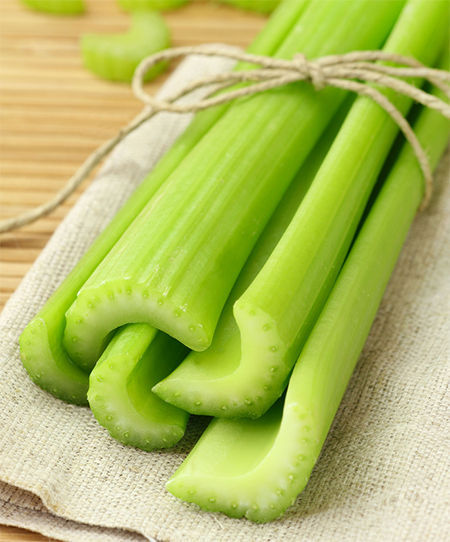
In fact, that's the common property among all negative-calorie foods: They all contain a lot of water locked in a fibrous matrix. Apples are essentially "water fruits," as are grapes and watermelons (hence the name). Many vegetables are also "water vegetables," meaning that they're loaded with water. Celery, for example, is the classic example of a water-rich negative-calorie food (see below).

As you read this list, remember that all foods contain calories, and that the term "negative-calorie food" is a bit of a misnomer. It refers to the effective net calories subtracted from your body through the preparation, eating, digestion and elimination of these foods. In other words, you expend more calories eating them than they deliver to your body.

The upshot is that the more water you consume in your foods, the more quickly you'll feel full and stop eating. Water, it turns out, is the most effective appetite control substance in the world.

So here's the list of the five best negative-calorie foods that you can enjoy every day as part of a healthy weight loss diet:


#1) Celery


One cup of celery (120g) contains only 19 calories. It takes far more than 19 calories to prepare, eat, digest and eliminate this one cup of celery, and that's what qualifies it as a negative-calorie food. You can eat as much celery as you want, and you won't gain body fat.

Even though celery contains effectively no contributing calories, it does contain powerful medicine. Celery juice is a powerful anti-inflammatory medicine and one of the active constituents in celery -- apigenin -- slashes the risk of ovarian cancer, too. 

Celery juice is fantastic for your health, but if you want to feel more full, eat whole celery with simple seasonings (see below).


#2) Lettuce, onions and greens


Lettuce is basically just structured water locked into a vegetable matrix. One cup of typical iceberg lettuce contains just 8 calories, meaning you can munch on this to your heart's delight and you'll never gain an ounce of body fat.

Much the same is true with onions, which contain only 64 calories per cup and yet deliver an amazing assortment of anti-cancer nutrients and immune-boosting medicine. 


Virtually all salad greens are "negative-calorie" foods, meaning you can eat as many of them as you want. But be careful: Slopping on 300 calories worth of oily salad dressing changes the entire equation. While lettuce by itself is a negative-calorie food, salad dressing is mostly definitely NOT. In fact, salad dressings are often loaded with cheap soybean oils and even MSG (monosodium glutamate), a chemical taste enhancer linked to neurological damage and obesity. MSG is almost always found in "Ranch" flavor dressings, in particular.


#3) Kelp noodles


Eating noodles is not normally known as a way to lose weight. That's because traditional noodles are made with calorie-rich starches derived from grains like wheat. But even spelt noodles, brown rice noodles and quinoa noodles still contain a lot of calories.

That's why kelp noodles are so amazing: They're made out of sea kelp, and they're packed with water. Yet they perform amazingly well in soups, raw noodle dishes and even Italian-style dishes like spaghetti.

Kelp noodles contain just 6 calories per serving, and yet they take up a lot of physical space in your belly, contributing to that "full" feeling that reminds you to stop eating.


You may be able to find kelp noodles at your local health food store. You can also find them at the NaturalNews Store, where we've just introduced them to readers who have replied with an overwhelmingly positive response. I've personally been eating these kelp noodles as part of my own health maintenance program. For example, during the week between Christmas and New Year's Day, I went on a juice fast that involved drinking fresh vegetable juice every morning, then eating steamed broccoli and cabbage with kelp noodles every evening.

It was a very cleansing and healthful experience. I also used several key supplements such as Oxy-Powder from Ed Group's Global Healing Center to help speed my cleansing.

Kelp noodles are also great for adding substance to light soups or vegetable broths. They make a broth eat like a full soup (and they make you feel full, too).


#4) Pickles


Pickles are, of course, made from cucumbers, and cucumbers are themselves a "negative-calorie food" because they're so sparse in calories. One cup of cucumbers contains a mere 16 calories.

Does that mean one cup of pickles contains 16 calories, too? Well, not exactly. You have to watch out for the sugar content in some brands of pickles. Just pickling cucumbers in vinegar, water and spices won't add any calories, but a lot of today's most popular pickle brands contain added sugar. This typically adds only a slight amount of calories to the food. Dill pickles made from cucumbers, for example, have 17 calories per cup.

So they're still a negative-calorie food because it takes more than 17 calories to consume and digest them. If you're looking to lose body fat or maintain a healthy weight, eat all the pickles you want.


Beware, however, of this: Many pickles are made with artificial yellow food coloring chemicals. In fact, I recently checked this out at the grocery store and found that 95% of the pickles sold there were contaminated with FD&C Yellow #5. This chemical should be avoided by everyone -- especially children.

So only buy natural pickles made without the yellow #5 food coloring!

By the way, speaking of pickled foods, you can also eat unlimited kimchi and raw sauerkraut as those are also negative-calorie fermented foods (they're actually good for your digestive tract because of all the probiotics they contain).


#5) Grapefruit


Grapefruit technically isn't a negative-calorie food, but it deserves mention for another reason as you'll soon see. For starters, it's still fairly low in calories, delivering only 74 calories per cup.

But the best part is that grapefruit contains naringenin, an antioxidant derived from the bitter flavor of grapefruits, which triggers the liver to break down fat. So as part of a fat-loss strategy, grapefruit is truly essential to your daily diet!

Fascinating research about the fat-reducing properties of grapefruit was just published in the online journal PLoS ONE. It shows that naringenin activates two kinds of PPARs (dubbed PPAR-alpha and PPARy) and blocks LXR-alpha -- resulting in fasting-type benefits to the body.


"It is a process which is similar to the Atkins diet, without many of the side effects," Martin L. Yarmush, MD, PhD, director of the MGH Center for Engineering in Medicine and one of the paper's authors, said in a media statement. "The liver behaves as if fasting, breaking down fatty acids instead of carbohydrates."

To get more grapefruit into my diet, I like to peel it, remove the seeds, then blend the whole grapefruit into a fruit smoothie. This is how I get the white grapefruit inner skin, too. And that contains the best medicine of the grapefruit!

Drinking so-called "grapefruit juice" does not offer the same benefits, especially if it's pasteurized. Only raw grapefruit that includes the white inner skin (the bitter part) offers these health benefits.


Don't forget full-spectrum sea salt


Believe it or not, full-spectrum salt (not processed salt) is actually a kind of negative-calorie substance. I'm including it as an addition to the list of five for reasons you'll see below.

There's a lot of mythology surrounding salt that needs to be dispelled here. First off, I'm not talking about processed white salt (sodium chloride). That's a dietary poison and should never be consumed. Only full-spectrum salt that's rich in sea minerals can be considered real food. In fact, many food cravings are really just cravings for minerals.

All land animals (and humans) have an innate biological need for real salt. That's why animals go crazy over salt licks. It's also why deer wander onto the roadways when they're salted in the winter. Land animals need salt, just like you and I. When we lack the trace minerals found in salt, we get cravings for salt.

Many cravings for salty snack foods are really just your brain telling you to eat more salt. And yet the salt used in processed foods isn't real salt -- it's fake salt; a shadow of real salt that lacks the trace minerals found in real salt.


So if you're craving chips or salty snack foods, you're probably deficient in real salt minerals and need to correct your nutritional deficiency. So sprinkling full-spectrum salt on your meals (steamed veggies, smoothies, etc.) can actually satisfy your cravings and reduce your consumption of unhealthful snack foods.

That's why full-spectrum salt is, for many people, an effective "negative-calorie" substance; because in those who are mineral deficient, eating full-spectrum salt can ease cravings by satisfying your body's desire for minerals.

However, if you show symptoms of high blood pressure, be sure to check with your naturopathic physician before adding salt to your diet. Most people consume far too much (processed) salt and need to drastically reduce their consumption of it before adding full-spectrum salt to their diets.

Some recommended full-spectrum salts include Royal Himalayan pink crystal salt, Celtic sea salt and other truly natural brands. Watch out for cheap "sea salt" at your grocery store -- it turns out that any salt can claim to be "sea salt" even if it's highly processed white salt. The thing to look for in salt is the color of the salt. Real salt will look pinkish, sandy or brown. The "dirtier" the color of the salt, the more real it is. The whiter is looks, the less healthy it is, just as in white bread versus wheat bread.


Feel full and drop the pounds anyway!


To summarize, then, here are the five negative-calorie foods that may help you feel full while greatly reducing your caloric intake:

• Celery
• Lettuce, onions and greens
• Kelp noodles
• Pickles, kimchi and sauerkraut
• Grapefruit

... and the additional item of:

• Full-spectrum sea salt

Isn't it nice to know you don't have to starve yourself to reduce your calories? Just eat more of these negative-calorie foods and you'll get the benefits of calorie restriction with all the suffering. Fill your grocery shopping cart with these foods, and you'll be the healthier for it!


Source

Saturday, 20 February 2016

Burning Fat With Flavonoids

Nuts appear to boost one’s metabolism, such that when we eat nuts we burn more of our own fat to compensate. People who don’t eat nuts tend to burn off around 20 grams of fat a day–about 5 pats worth of butter, but those eating walnuts averaged more like 31 grams–7 or 8 pats of butter. In Fat Burning Via Arginine, I explore one theory as to why this may happen (and where arginine can be found in our diet).

It may also be the flavonoids, phytonutrients found in nuts as well as citrus, berries, red onions, beans, green tea, grapes, and cocoa, that may boost our metabolism enough to significantly slim our waistline. Based on what kind of evidence? I showcase a study done on purple grape juice in my video Fat Burning Via Flavonoids.
Just like nuts are calorically dense yet don’t seem to cause much weight gain, Welch’s was hoping that the same would be found for their grape juice. They had people guzzle down 2 cups a day for three months. Keep in mind that Welch’s grape juice has more sugar than Coca Cola. Two cups of purple grape juice contain the equivalent of 20 spoonfuls of sugar. The control group was basically given grape Kool-Aid instead, with the same number of calories and same amount of sugar, but no detectable phytonutrients.

At two cups a day study subjects were getting hundreds of extra calories a day. Surely after 3 months they’d gain a couple pounds. Indeed that’s what happened in the grape-flavored sugar water group—how could they not with all that extra sugar in their diet? The grape juice group, on the other hand, did not. In fact, their waist circumference shrunk significantly. Drinking grape juice appeared to burn away significantly more tummy fat. So maybe there is something to the theory put forth by the nut and green tea researchers that flavonoid phytonutrients are capable of helping the body burn fat. If true, then it’s just one more reason to eat nuts and drink green tea—not grape juice. Instead of the juice, I’d recommend eating concord grapes, the source of purple grape juice that you may be able to find at a farmer’s market near you.


Source

Thursday, 26 November 2015

How many calories should I burn a day to lose weight?

From my experience a lot of people hesitate to even try and lose weight because they don’t know from where to start. They know that they should go on a diet and exercise regime but the lack of measurable goals creates uncertainty and this leads to failure before to even begin! To bypass this problem and have clear goals on what you want to achieve, you can start your weight loss process by doing some simple calorie calculations. By calculating how many calories you should be eating per day and how many calories you should be burning per day, you can have a better picture about your daily calorie needs and a rough estimate as to when you will be able to reach your ideal weight.


Before getting into the mathematical part let me explain some basic weight loss concepts that will help you understand what these numbers mean. You do not have to keep a pen and paper because our daily calorie calculator will do the hard part.

When do you lose weight?

There are many factors that affect how much weight you can lose (and when) but in its simplest form weight loss will occur when the calories you burn are more than the calories you consume.  Food and drinks (think diet) are the only sources for calories you consume while exercise, physical activity and other body factors affect the rate you burn calories. So if you manage to control these 2 sources and create a calorie deficit you will eventually start losing weight.

How many calories are in a pound?

Let’s add one more parameter to our equation which is 1 pound of fat = 3500 calories aprx. This means that if you consume 3500 more calories than what you burn in a period of time you will gain one pound but if you manage to burn 3500 more calories than you consume you will lose 1 pound.

What is my daily calorie requirement?

Many studies have found that in general women need 1500-2000 kcal to maintain their current weight and for men the range goes to 2000-2500 Kcal. This number is also known as the Basic Metabolic Rate (BMR). In essence this figure gives you the number of calories your body needs on a daily basis in order to function properly.
Note: This is not how many calories you consume per day but how many calories your body needs to function.

Daily calorie needs to maintain current weight = BMR x Activity Factor

For example if your BMR is 1600 and you are lightly active during the day then your daily calorie requirements are: 1600 x 1.375 = 2200 kcal per day. 2200 calories are needed so that you maintain your current weight. If you want to lose weight you should be consuming less than 2200 calories per day and if you want to gain weight you should be consuming more than 2200 calories per day.

How many calories to eat if you want to lose weight?

Before getting into a real example of how to calculate the calories you should be eating per day for weight loss let me say that this is only an estimate and it is not guaranteed that by following this number you will lose or gain weight. There are many other factors involved in losing weight and the number of calories you consume is just one of the elements and since it is easy to calculate you can use it as your starting point.
Let’s assume that you need to lose 5lb in 2 months, this is how you calculate the amounts of calories to eat per day:
Step 1: Calculate your BMR and daily calorie needs
After using our BMR and daily calorie calculator you found that: BMR is 1800 calories and daily calorie needs are 2000 kcal.
Step 2: Calculate the calories you want to lose
You want to lose 5lb which is aprx 17500 calories (1lb of fat is 3500 calories)
Step 3: Calculate how many calories you need to save per day
Your goal is not lose 5lb in 2 months. Doing some basic calculations you can find out that 17500 calories in 2 months is about 8750 calories per month or 2187 per week or 313 kcal per day. So in theory, if you manage to save 313 calories per day you will lose 5lb in 2 months
Step 3: Subtract the number of calories you need to save per day (Step 3 above) from your daily calorie needs (step 1 above)
Daily Calorie needs – Calorie savings per day = 2000 – 313 = 1687 kcal per day. This is the number of calories you need to eat per day if you want to lose 5lb in 2 months!

How many calories to burn per day if you want to lose weight?

Since you know the number of calories you should be eating per day, you can use a calorie counter to calculate the amount of calories you actually eat (or drink) on a daily basis and find out the amount of calories you need to burn via exercise if you want to lose weight.
Hint: You can use our Free Calorie Counter to keep count of your meals and activities.
For example if you are consuming  1800 calories per day and in order to lose weight you need to consume only 1687 calories per day (as calculated above) then this means that you should burn 113 kcal per day by doing exercise.

What you should know when doing your calculations

  1. When you start a diet or weight loss program you will not only lose fat. Especially at the beginning you will lose water weight and in some cases you may also lose muscle. So the results in the first few weeks may be misleading.
  2. When you make sudden or drastic changes to your diet the body will try to adapt by lowering the metabolic rate. In other words it enters a protective mode by reducing the number of calories it needs per day. As a result weight loss may slow down, here is how to lose weight and keep it off.
  3. The absolute minimum amount of calories you can consume per day is 1000-1100 kcal. It is not recommended to go beyond this number for any reason.
  4. The recommended weight to lose per week is between 1 – 1.5 pounds. Anything above that can have other implications to your health and normal body functioning.
  5. Do not forget that drinks also carry calories so make sure that you include drinks in your daily calorie calculations. You can read our article on the 5 best healthy weight loss drinks that work to find out which drinks are ‘weight loss friendly’.
  6. You can use a technique called “calorie cycling” to make the process easier to follow. This means that once you calculate your daily calorie needs you can go above and below this range on different days of the week. If for example you daily kcal needs are 1700 you can choose to go above this number on Monday and Wednesday and below this number the rest days of the week but try to avoid exaggerations. You can also read about carb cycling to access if this is something you want to try for your diet.
  7. Make sure that you give correct measurements for your weight and height when calculating your BMR.
  8. Do not lie about your activity level but try to be as accurate as possible.
  9. Do not decrease your daily calorie intake by more than 500 kcal per day. Better expand the time period. Reducing your intake by 500 kcal is a lot and very difficult to follow for a long time.
  10. Always consult your doctor or dietician before making any changes to your diet or exercise routine.
As explained above you can use these calculations to give you an idea where you stand and how much effort you need to make until you meet your goals and target weight. Weight loss depends on a lot more factors and calculating the calories you need per day is just your starting point.
Comment below if you found this helpful, and let me know if you have any tips to burn calories.


Source

Friday, 30 October 2015

Amino acids and their significance for fat burning

Amino acids, vitamins, minerals and trace elements play a significant role in weight loss.


Whether we gradually put on weight or stay slim generally depends on our hormones. And herein lays the key to weight loss: the systematic supplementation of certain amino acids allows us to stimulate the body to produce enough fat-burning hormones – in a natural manner and in harmony with the body's needs. 
One important fat-burning hormone is the growth hormone (somatotropin, STH). We produce this hormone while we sleep. It stimulates protein synthesis and boosts fat oxidation. Overweight patients generally have lower STH concentrations, which often hinders weight reduction. Unfortunately, the growth hormone is very expensive (approximately GBP 400–650 for a monthly ration) and must be injected under close and competent medical supervision. It is thus safer to simulate our bodies to secrete this hormone naturally. Certain amino acids have been shown to do this in many cases if sufficient quantities are taken on an empty stomach at night.

Amino acids capable of this are:

  • Arginine
  • Glutamine
  • Methionine
The synthesis of the growth hormone also requires vitamin B6, vitamin B12 and zinc.

Studies have shown that obese patients may have a carnitine deficiency.

In this case, carnitine substitution (food supplementation) is certainly worthwhile. Carnitine is a biocarrier (transport substance), which is synthesised in the liver – and its precursor in the kidneys – from the two essential amino acids lysine and methionine. It acts as a carrier molecule that transports long-chain fatty acids through the inner mitochondrial membrane. Long-chain fatty acids can only pass through the membrane if they have been esterified with carnitine, whereas medium- and short-chain fatty acids can pass without this carrier (transport molecule)

Carnitine as a fat burner

Carnitine transports fatty acids more quickly and throws them into the metabolic furnace. This means that the body is burning fat instead of storing it. Owing to its fat-oxidising effect, carnitine is also used for weight reduction and is often referred to as a “fat burner”.
Carnitine is synthesised in five steps that also involve the essential co-factors vitamin B6, vitamin B12, niacin and folic acid. A deficiency in any of these substances may limit carnitine biosynthesis.
Professor Luppa from the University of Leipzig wrote about the fat-burning capabilities of l-carnitine in his essay from 2004, “in regards to the prevention of obesity, it can be said that current measures to improve the breakdown of fat are more effective than the propagated restrictions on fat intake in the diet. However, the precondition is the optimal functioning of the fat metabolism and its regulation. L-carnitine plays a decisive role as an essential co-factor in both cases. A deficiency in l-carnitine reduces the breakdown of fatty acids in the mitochondrial matrix due to its function as a carrier. L-carnitine is also important in regulating fat and carbohydrate metabolism for it is a substrate of the carnitine palmitoyl transferase (CPT).”
Furthermore, “restrictions in the availability of l-carnitine are not only recognisable in the adaptability of the lipid metabolism as the carbohydrate and protein metabolisms are also affected. As a consequence, reduced blood sugar levels and increased protein degradation can occur.”

There was clear evidence that carnitine can increase fat oxidation in certain cells of the body.

Furthermore, work by two scientists from Switzerland and the USA has now proved that the administration of carnitine can boost mobilization of fatty acids from the adipocytes (fat cells) and also increase oxidation of fatty acids in these cells.
Moreover, sufficient data has been obtained from seven animal models which all clearly prove that carnitine supplementation during a calorie-reduced diet can lead not only to a significant decrease in the body fat compared to a placebo, but also to a simultaneous increase in fat-free muscle mass.

Carnitine facilitates weight management

A 2013 clinical study has attracted a great deal of attention. It showed that dietary supplementation with 500mg L-carnitine per day, in combination with motivational training, already ensures significant weight loss in overweight individuals. Study participants were able to lose an average of 400g of body fat within four weeks, without changing their diets or level of exercise. Waist circumference measurements showed an average decrease of 1.3cm.

Glutamine counteracts fat storage

Glutamine can be converted to glucose in the kidneys without affecting the glucagon and insulin counts. Therefore, it also contributes to the energy supply while being able to bypass insulin-induced fat storage.
It counteracts the storage of dietary fats and thus helps regulate weight. One study showed that supplementation with glutamine in a high-fat diet resulted in a loss of body fat. Furthermore, glutamine can reduce cravings for sugar and alcohol.
The B-vitamins and zinc are also important for fat burning. Vitamin B is very helpful when trying to lose weight, as almost all of the B-vitamins stimulate the body’s ability to break down fat. Moreover, they are also a nutritional source for the nerves, a factor which should not be underestimated, especially by those who wish to lose weight. The B-vitamins riboflavin (B2), niacin (B3), pantothenic acid (B5), biotin (B7) and cobalamin (B12) are responsible for controlling the metabolism and stimulate the breakdown of body fats. They are particularly effective and fast in regards to fat burning. Vitamin B2 is important as it quickly converts proteins, carbohydrates and fats to energy. The trace element zinc has similar properties for it supports the body in processing fat and carbohydrates and it is indispensable for a functioning protein metabolism. Amino acids can therefore only fulfil their important tasks for the lipid metabolism with a sufficient supply of zinc.


Source
http://www.aminoacid-studies.com/areas-of-use/fat-burning.html

Sources

1Rudman, D., Feller, A.G., Cohn, L., Shetty, K.R., Rudman, I.W. & Draper, M.W. (1991) Effects of human growth hormone on body composition Hormone research, Volume 36 supplement 1, (pp. 73-81)
2Merimee, T.J., Lillicrap, D.A. & Rabinowitz, D. (1965) Effect of arginine on serum-levels of human growth-hormone Lancet, Volume 2, issue 7414, (pp. 668-670)
3Welbourne, T.C. (1995) Increased plasma bicarbonate and growth hormone after an oral glutamine load,The American Journal Of Clinical Nutrition, Volume 61, issue 5, (pp. 1058-1061)
4Kasai, K., Kobayashi, M. & Shimoda, S.I. (1978) Stimulatory effect of glycine on human growth hormone secretion, Metabolism, Clinical and Experimental, Volume 27, issue 2, (pp. 201-208)
5Evangeliou, A. & Vlassopoulos, D. (2003) Carnitine Metabolism and Deficit – When Supplementation is Necessary? Current Pharmaceutical Biotechnology (pp. 211-219)
6Müller, D.M., Seim, H., Kiess, W., Löster, H. & Richter, T. (2002) Effects of Oral l-Carnitine Supplementation on In Vivo Long-Chain Fatty Acid Oxidation in Healthy Adults, Metabolism, Vol. 51, issue 11, (pp. 1389-1391)
7Wutzke, K.D. & Lorenz, H. (2004) The Effect of l-Carnitine on Fat Oxidation, Protein Turnover, and Body Composition in Slightly Overweight Subjects, Metabolism, Vol. 53, issue 8, (pp. 1002-1006)
8Reda, E., D'Iddio, S., Nicolai, R., Benatti, P. & Calvani, M. (2003) The Carnitine System and Body Composition, Acta Diabetol, issue 40, (pp. 106-113)
9Odo, S., Tanabe, K. & Yamauchi, M. (2013) A Pilot Clinical Trial on L-Carnitine Supplementation in Combination with Motivation Training: Effects on Weight Management in Healthy Volunteers, Food and Nutrition, Volume 4, (pp. 222-231)
10Prada, P.O., Hirabara, S.M., de Souza, C.T., Schenka, A.A., Zecchin,H.G., Vassallo, J., Velloso, L.A., Carneiro, E., Carvalheira, J.B., Curi, R. & Saad, M.J. (2007) L-glutamine supplementation induces insulin resistance in adipose tissue and improves insulin signalling in liver and muscle with diet-induced obesity,Diabetologia, Volume 50, issue 9, (pp. 149-159)
11Bowtell, J.L., Gelly, K., Jackman, M.L., Patel, A., Simeoni, M. & Rennie, M.J. (1999) Effect of oral glutamine on whole body carbohydrate storage during recovery from exhaustive exercise, Journal Of Applied Physiology, Volume 86, issue 6, (pp. 1770-1777)