

Because of their surprising lack of calories, these foods can essentially be consumed in unlimited quantities without you gaining weight (body fat). That works because your stomach senses when it is physically full, and it will trigger your brain to stop eating when you can't handle more food. You know that "I feel stuffed" feeling? That's your stomach (which has its own complex nervous system, by the way), telling your brain to tell you to stop eating.
This is why, believe it or not, the simple act of drinking a glass of water before each meal is a proven weight loss strategy. It fills your belly with water, thereby reducing the amount of space left for other foods. So your stomach gets full more quickly, triggering the "stop eating" signals in your brain.
Eating an apple before each meal also works in much the same way. This is true even though apples are not negative-calorie foods. But they are rich in water, and water takes up space in your stomach.
In fact, that's the common property among all negative-calorie foods: They all contain a lot of water locked in a fibrous matrix. Apples are essentially "water fruits," as are grapes and watermelons (hence the name). Many vegetables are also "water vegetables," meaning that they're loaded with water. Celery, for example, is the classic example of a water-rich negative-calorie food (see below).
As you read this list, remember that all foods contain calories, and that the term "negative-calorie food" is a bit of a misnomer. It refers to the effective net calories subtracted from your body through the preparation, eating, digestion and elimination of these foods. In other words, you expend more calories eating them than they deliver to your body.
The upshot is that the more water you consume in your foods, the more quickly you'll feel full and stop eating. Water, it turns out, is the most effective appetite control substance in the world.
So here's the list of the five best negative-calorie foods that you can enjoy every day as part of a healthy weight loss diet:
#1) Celery
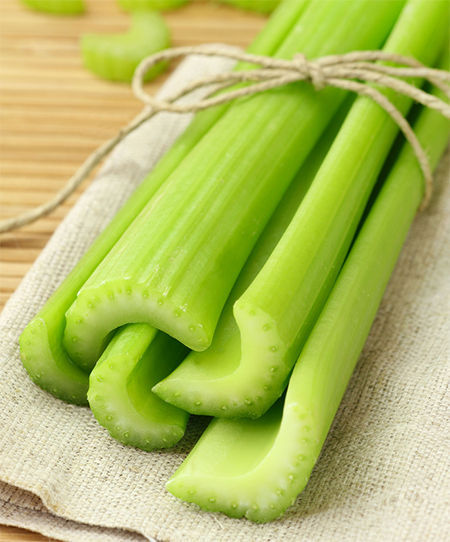 One cup of celery (120g) contains only 19 calories. It takes far more than 19 calories to prepare, eat, digest and eliminate this one cup of celery, and that's what qualifies it as a negative-calorie food. You can eat as much celery as you want, and you won't gain body fat.
Even though celery contains effectively no contributing calories, it does contain powerful medicine. Celery juice is a powerful anti-inflammatory medicine and one of the active constituents in celery -- apigenin -- slashes the risk of ovarian cancer, too.
Celery juice is fantastic for your health, but if you want to feel more full, eat whole celery with simple seasonings (see below).
#2) Lettuce, onions and greens
Much the same is true with onions, which contain only 64 calories per cup and yet deliver an amazing assortment of anti-cancer nutrients and immune-boosting medicine.

Virtually all salad greens are "negative-calorie" foods, meaning you can eat as many of them as you want. But be careful: Slopping on 300 calories worth of oily salad dressing changes the entire equation. While lettuce by itself is a negative-calorie food, salad dressing is mostly definitely NOT. In fact, salad dressings are often loaded with cheap soybean oils and even MSG (monosodium glutamate), a chemical taste enhancer linked to neurological damage and obesity. MSG is almost always found in "Ranch" flavor dressings, in particular.
#3) Kelp noodles
That's why kelp noodles are so amazing: They're made out of sea kelp, and they're packed with water. Yet they perform amazingly well in soups, raw noodle dishes and even Italian-style dishes like spaghetti.
Kelp noodles contain just 6 calories per serving, and yet they take up a lot of physical space in your belly, contributing to that "full" feeling that reminds you to stop eating.

You may be able to find kelp noodles at your local health food store. You can also find them at the NaturalNews Store, where we've just introduced them to readers who have replied with an overwhelmingly positive response. I've personally been eating these kelp noodles as part of my own health maintenance program. For example, during the week between Christmas and New Year's Day, I went on a juice fast that involved drinking fresh vegetable juice every morning, then eating steamed broccoli and cabbage with kelp noodles every evening.
It was a very cleansing and healthful experience. I also used several key supplements such as Oxy-Powder from Ed Group's Global Healing Center to help speed my cleansing.
Kelp noodles are also great for adding substance to light soups or vegetable broths. They make a broth eat like a full soup (and they make you feel full, too).
#4) Pickles
Does that mean one cup of pickles contains 16 calories, too? Well, not exactly. You have to watch out for the sugar content in some brands of pickles. Just pickling cucumbers in vinegar, water and spices won't add any calories, but a lot of today's most popular pickle brands contain added sugar. This typically adds only a slight amount of calories to the food. Dill pickles made from cucumbers, for example, have 17 calories per cup.
So they're still a negative-calorie food because it takes more than 17 calories to consume and digest them. If you're looking to lose body fat or maintain a healthy weight, eat all the pickles you want.

Beware, however, of this: Many pickles are made with artificial yellow food coloring chemicals. In fact, I recently checked this out at the grocery store and found that 95% of the pickles sold there were contaminated with FD&C Yellow #5. This chemical should be avoided by everyone -- especially children.
So only buy natural pickles made without the yellow #5 food coloring!
By the way, speaking of pickled foods, you can also eat unlimited kimchi and raw sauerkraut as those are also negative-calorie fermented foods (they're actually good for your digestive tract because of all the probiotics they contain).
#5) Grapefruit
But the best part is that grapefruit contains naringenin, an antioxidant derived from the bitter flavor of grapefruits, which triggers the liver to break down fat. So as part of a fat-loss strategy, grapefruit is truly essential to your daily diet!
Fascinating research about the fat-reducing properties of grapefruit was just published in the online journal PLoS ONE. It shows that naringenin activates two kinds of PPARs (dubbed PPAR-alpha and PPARy) and blocks LXR-alpha -- resulting in fasting-type benefits to the body.

"It is a process which is similar to the Atkins diet, without many of the side effects," Martin L. Yarmush, MD, PhD, director of the MGH Center for Engineering in Medicine and one of the paper's authors, said in a media statement. "The liver behaves as if fasting, breaking down fatty acids instead of carbohydrates."
To get more grapefruit into my diet, I like to peel it, remove the seeds, then blend the whole grapefruit into a fruit smoothie. This is how I get the white grapefruit inner skin, too. And that contains the best medicine of the grapefruit!
Drinking so-called "grapefruit juice" does not offer the same benefits, especially if it's pasteurized. Only raw grapefruit that includes the white inner skin (the bitter part) offers these health benefits.
Don't forget full-spectrum sea salt
There's a lot of mythology surrounding salt that needs to be dispelled here. First off, I'm not talking about processed white salt (sodium chloride). That's a dietary poison and should never be consumed. Only full-spectrum salt that's rich in sea minerals can be considered real food. In fact, many food cravings are really just cravings for minerals.
All land animals (and humans) have an innate biological need for real salt. That's why animals go crazy over salt licks. It's also why deer wander onto the roadways when they're salted in the winter. Land animals need salt, just like you and I. When we lack the trace minerals found in salt, we get cravings for salt.
Many cravings for salty snack foods are really just your brain telling you to eat more salt. And yet the salt used in processed foods isn't real salt -- it's fake salt; a shadow of real salt that lacks the trace minerals found in real salt.

So if you're craving chips or salty snack foods, you're probably deficient in real salt minerals and need to correct your nutritional deficiency. So sprinkling full-spectrum salt on your meals (steamed veggies, smoothies, etc.) can actually satisfy your cravings and reduce your consumption of unhealthful snack foods.
That's why full-spectrum salt is, for many people, an effective "negative-calorie" substance; because in those who are mineral deficient, eating full-spectrum salt can ease cravings by satisfying your body's desire for minerals.
However, if you show symptoms of high blood pressure, be sure to check with your naturopathic physician before adding salt to your diet. Most people consume far too much (processed) salt and need to drastically reduce their consumption of it before adding full-spectrum salt to their diets.
Some recommended full-spectrum salts include Royal Himalayan pink crystal salt, Celtic sea salt and other truly natural brands. Watch out for cheap "sea salt" at your grocery store -- it turns out that any salt can claim to be "sea salt" even if it's highly processed white salt. The thing to look for in salt is the color of the salt. Real salt will look pinkish, sandy or brown. The "dirtier" the color of the salt, the more real it is. The whiter is looks, the less healthy it is, just as in white bread versus wheat bread.
Feel full and drop the pounds anyway!
• Celery
• Lettuce, onions and greens
• Kelp noodles
• Pickles, kimchi and sauerkraut
• Grapefruit
... and the additional item of:
• Full-spectrum sea salt
Isn't it nice to know you don't have to starve yourself to reduce your calories? Just eat more of these negative-calorie foods and you'll get the benefits of calorie restriction with all the suffering. Fill your grocery shopping cart with these foods, and you'll be the healthier for it!
Source


