Showing posts with label healthy food. Show all posts

Sunday, 18 September 2016

What a Nutritionist Eats in a Week

nutritionist eats

I do believe in everything in moderation. I follow an 80/20 philosophy with my diet – where the 80% accounts for nourishing wholefoods, like organically sourced fruits/veggies/meat and plenty of good fats – and the 20% includes healthy treats in moderation; a few squares of dark chocolate or a glass of red wine at the end of the day. Enjoy the 20%, but make sure you are having a good quality animal protein and loads of colourful and green veggies to go with it!
Here is what a week on my plate looks like – I make sure to include heaps of variety – eating the rainbow is truly the easiest way to make sure you get all the essential nutrients your body needs!

Monday:
Pre breakfast: lemon and ginger warm water + yoga + belly breathing exercise. (Everyday)
+ Morning piccolo coffee – 1 shot of coffee with a small serve of hot milk.
Breakfast: 1/2 cup organic rolled oats cooked in water/almond/coco milk and cinnamon. Topped with berries, a scoop of vanilla pea protein and some mixed seeds. It is so important to get some good fats and proteins in at breakfast time to keep your blood sugar levels stable until dinner.
Daily vitamins: Fish oil, Multi mineral, Vitamin C. (repeated daily)
Snack: Green apple with cinnamon and ginger lemon tea
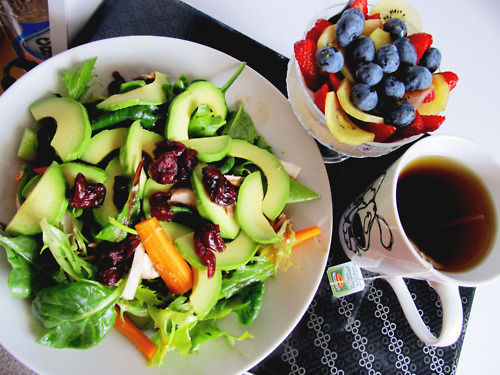
Lunch: Salmon trout served on a mixed leaf salad with avocado slices. Lemon juice and Dijon mustard mixed together for the dressing.
Snack: Carrot sticks with clean hummus
Dinner: Grilled sea bass/snapper with sautéed/steamed garlic broccoli and grilled asparagus. Lemon ginger tea/chamomile.
Nighttime vitamins: Magnesium powder and a probiotic.

Tuesday:
Breakfast: Power protein shake: scoop of vanilla pea/whey protein, 1/2 frozen banana, 1/2 cup frozen berries, 1 tbsp chia seeds, cinnamon, 1 tsp almond butter, vanilla stevia, 1 cup ice cubes, 1 cup almond milk. Blend. This keeps me so full and satisfied all morning.
+ Morning piccolo coffee – 1 shot of coffee with a small serve of hot milk.
Snack: small handful of raw almonds
Lunch: Tuna and roasted cauliflower salad: a bed of lettuce, chopped carrot, artichokes, avocado, onion, cucumber and roasted cumin spiced cauliflower. Tossed with sesame dressing made from Dijon mustard, sesame oil, tamari and white balsamic.
Dinner: Grilled salmon served with pesto green beans and a mixed salad

Wednesday:
Breakfast: 150-200g Greek yoghurt/Coyo with 1/2 cup mixed berries. Add a sprinkle of pumpkin seeds, sunflower seeds and chia seeds. Top with a handful of raw almonds and a drizzle of honey/stevia/cinnamon to sweeten.
+ Morning piccolo coffee – 1 shot of coffee with a small serve of hot milk.
Snack: 1x boiled egg + fresh green juice
Lunch: Grilled chicken and avocado salad with rocket leaves and grilled zucchini. Top with balsamic vinegar and olive oil.
Snack: Carrot and cucumber sticks with tahini dip
Dinner: Piece of lean eye fillet steak served with cauliflower mash (recipe from my book, The Healthy Life) and roasted sweet potato slices.
Dessert: 2-3 pieces of 80% dark chocolate.

Thursday:
Breakfast: Power protein shake: scoop of vanilla pea/whey protein, 1/2 frozen banana, 1/2 cup frozen berries, 1 tbsp chia seeds, cinnamon, 1 tsp almond butter, vanilla stevia, 1 cup ice cubes, 1 cup almond milk. Blend. This keeps me so full and satisfied all morning.
+ Morning piccolo coffee – 1 shot of coffee with a small serve of hot milk.
Snack: 1 cup of blueberries sprinkled with cinnamon
Lunch: Tuna and avocado brown rice sushi – from my local Japanese café.
Snack: 150g Greek yoghurt sweetened with cinnamon and stevia granules. Topped with some raw almonds – keeps my blood sugar levels nice and stable until dinner.
Dinner: Snapper in a bag – with lemon, rosemary and garlic – baked in the oven. Served with sautéed garlic spinach and a fresh green salad.

Friday:
Breakfast: 1/2 papaya with a squeeze of lime juice. Topped with Greek yoghurt and mixed seeds.
+ Morning piccolo coffee – 1 shot of coffee with a small serve of hot milk.
Snack: Carrot sticks with a smear of almond butter
Lunch: Pesto Zucchini pasta with chicken breast – amazing pasta alternative. So satisfying.
Snack: Herbal tea
Dinner: Grilled lemon and herb chicken breast served with sweet potato mash.
Post dinner: Chai tea with almond milk and cinnamon

Saturday
Image result for cinnamon oats tumblrBreakfast: Warm cinnamon oats topped with 2 tbsp Greek yoghurt, banana slices and a mix of nuts and seeds.
+ Morning piccolo coffee – 1 shot of coffee with a small serve of hot milk.
Snack: 1 carrot sliced – sprinkled with rock salt.
Lunch: Chicken, pumpkin and avocado salad – spinach leaves as the based. Drizzled with a miso salad dressing.
Snack: My signature Power Protein shake – minus the fruit.
Dinner: Garlic and Ginger Prawn stir fry – with lots of greens and fresh herbs. Served with brown rice. Glass of red wine.

Sunday:
Breakfast: Treat breakfast of an Acai bowl from a local acai bar in Bondi.
Snack: Morning piccolo coffee
Lunch: Roasted chicken with grilled parmesan asparagus and big salad – enjoyed with my family.
Snack: Greek yoghurt sweetened with cinnamon and stevia
Dinner: Scrambled eggs with pesto and served with avocado – Sunday nights are always easy egg night!


Source


Saturday, 11 June 2016

The Best Times to Eat for Weight Loss

How and when you eat can impact your health—and your 

weight. Upgrade your eating habits to maximize fat burning 

and keep hunger at bay


Certainly what we eat has an enormous impact on our health and weight status. But did you know that when and how we eat also make a huge difference? Eating at the appropriate times throughout the day will help to maximize fat burning and keep hunger at bay.
Aim to eat every 3 to 4 hours. Most people eat three meals and one snack, while others may prefer four smaller meals; you're free to find the combination that works best for you. Timing your meals in this way will improve your fat loss by preventing excess insulin, allowing leptin to work its magic on appetite control and metabolism, and by balancing the stress hormone cortisol. You should also enjoy your meals at the same time every day.
Eat within 1 hour of rising. Your mom was also right when she told you breakfast was the most important meal of the day. When you skip breakfast, you lose its stimulating benefits on your metabolic rate. You also become more likely to eat unbalanced meals, more calories, and larger amounts of saturated fat throughout the day. Plenty of research shows that those of us who skip breakfast are actually heavier. Missing out on a healthy morning meal also increases stress hormones.

Never eat within 3 hours of bedtime. Eating too close to bedtime raises your body temperature, increases blood sugar and insulin, prevents the release of melatonin, and cuts down on growth hormone release. All these factors interfere with the quality of your sleep and the natural fat-burning benefits of a good night’s rest. Furthermore, sleep deprivation leads to more cravings and a greater likelihood of overeating the next day.
If you must eat before bed, opt for a light meal or snack that's high in protein and low in carbohydrates and fat, such as a protein shake made with berries and water, salad with grilled chicken, or a shrimp and veggie stir-fry.
Start the day with protein. For better appetite control throughout the day, try combining your starchy carbs at lunch, dinner, or after your workouts rather than at breakfast. Stick to eggs or whey protein smoothies for breakfast and you'll eat less throughout the day.
Always eat within 45 minutes of finishing your workout. This meal or snack is the only one of the day that should not contain much fat and should be higher in carbohydrates. For example, have a smoothie made with juice, fruit, and protein powder, but no flaxseeds or oil.
Never do your weight training on an empty stomach. You will need energy from your foods to perform optimally. You may, however, complete your cardio before eating if your session will be less than 30 minutes.
Focus on your food. Do not eat while you are doing anything else (i.e., watching TV, working, surfing on the computer, etc.). Focus on chewing your food and relaxing while you eat.
Eat protein first. Eat the protein on your plate first to help speed the signal to your brain that you are full.
Drink alcohol last. If you have alcohol or wine, do so after your meal to enhance the hormones involved in appetite control and digestion.


Source

Thursday, 26 November 2015

How many calories should I burn a day to lose weight?

From my experience a lot of people hesitate to even try and lose weight because they don’t know from where to start. They know that they should go on a diet and exercise regime but the lack of measurable goals creates uncertainty and this leads to failure before to even begin! To bypass this problem and have clear goals on what you want to achieve, you can start your weight loss process by doing some simple calorie calculations. By calculating how many calories you should be eating per day and how many calories you should be burning per day, you can have a better picture about your daily calorie needs and a rough estimate as to when you will be able to reach your ideal weight.


Before getting into the mathematical part let me explain some basic weight loss concepts that will help you understand what these numbers mean. You do not have to keep a pen and paper because our daily calorie calculator will do the hard part.

When do you lose weight?

There are many factors that affect how much weight you can lose (and when) but in its simplest form weight loss will occur when the calories you burn are more than the calories you consume.  Food and drinks (think diet) are the only sources for calories you consume while exercise, physical activity and other body factors affect the rate you burn calories. So if you manage to control these 2 sources and create a calorie deficit you will eventually start losing weight.

How many calories are in a pound?

Let’s add one more parameter to our equation which is 1 pound of fat = 3500 calories aprx. This means that if you consume 3500 more calories than what you burn in a period of time you will gain one pound but if you manage to burn 3500 more calories than you consume you will lose 1 pound.

What is my daily calorie requirement?

Many studies have found that in general women need 1500-2000 kcal to maintain their current weight and for men the range goes to 2000-2500 Kcal. This number is also known as the Basic Metabolic Rate (BMR). In essence this figure gives you the number of calories your body needs on a daily basis in order to function properly.
Note: This is not how many calories you consume per day but how many calories your body needs to function.

Daily calorie needs to maintain current weight = BMR x Activity Factor

For example if your BMR is 1600 and you are lightly active during the day then your daily calorie requirements are: 1600 x 1.375 = 2200 kcal per day. 2200 calories are needed so that you maintain your current weight. If you want to lose weight you should be consuming less than 2200 calories per day and if you want to gain weight you should be consuming more than 2200 calories per day.

How many calories to eat if you want to lose weight?

Before getting into a real example of how to calculate the calories you should be eating per day for weight loss let me say that this is only an estimate and it is not guaranteed that by following this number you will lose or gain weight. There are many other factors involved in losing weight and the number of calories you consume is just one of the elements and since it is easy to calculate you can use it as your starting point.
Let’s assume that you need to lose 5lb in 2 months, this is how you calculate the amounts of calories to eat per day:
Step 1: Calculate your BMR and daily calorie needs
After using our BMR and daily calorie calculator you found that: BMR is 1800 calories and daily calorie needs are 2000 kcal.
Step 2: Calculate the calories you want to lose
You want to lose 5lb which is aprx 17500 calories (1lb of fat is 3500 calories)
Step 3: Calculate how many calories you need to save per day
Your goal is not lose 5lb in 2 months. Doing some basic calculations you can find out that 17500 calories in 2 months is about 8750 calories per month or 2187 per week or 313 kcal per day. So in theory, if you manage to save 313 calories per day you will lose 5lb in 2 months
Step 3: Subtract the number of calories you need to save per day (Step 3 above) from your daily calorie needs (step 1 above)
Daily Calorie needs – Calorie savings per day = 2000 – 313 = 1687 kcal per day. This is the number of calories you need to eat per day if you want to lose 5lb in 2 months!

How many calories to burn per day if you want to lose weight?

Since you know the number of calories you should be eating per day, you can use a calorie counter to calculate the amount of calories you actually eat (or drink) on a daily basis and find out the amount of calories you need to burn via exercise if you want to lose weight.
Hint: You can use our Free Calorie Counter to keep count of your meals and activities.
For example if you are consuming  1800 calories per day and in order to lose weight you need to consume only 1687 calories per day (as calculated above) then this means that you should burn 113 kcal per day by doing exercise.

What you should know when doing your calculations

  1. When you start a diet or weight loss program you will not only lose fat. Especially at the beginning you will lose water weight and in some cases you may also lose muscle. So the results in the first few weeks may be misleading.
  2. When you make sudden or drastic changes to your diet the body will try to adapt by lowering the metabolic rate. In other words it enters a protective mode by reducing the number of calories it needs per day. As a result weight loss may slow down, here is how to lose weight and keep it off.
  3. The absolute minimum amount of calories you can consume per day is 1000-1100 kcal. It is not recommended to go beyond this number for any reason.
  4. The recommended weight to lose per week is between 1 – 1.5 pounds. Anything above that can have other implications to your health and normal body functioning.
  5. Do not forget that drinks also carry calories so make sure that you include drinks in your daily calorie calculations. You can read our article on the 5 best healthy weight loss drinks that work to find out which drinks are ‘weight loss friendly’.
  6. You can use a technique called “calorie cycling” to make the process easier to follow. This means that once you calculate your daily calorie needs you can go above and below this range on different days of the week. If for example you daily kcal needs are 1700 you can choose to go above this number on Monday and Wednesday and below this number the rest days of the week but try to avoid exaggerations. You can also read about carb cycling to access if this is something you want to try for your diet.
  7. Make sure that you give correct measurements for your weight and height when calculating your BMR.
  8. Do not lie about your activity level but try to be as accurate as possible.
  9. Do not decrease your daily calorie intake by more than 500 kcal per day. Better expand the time period. Reducing your intake by 500 kcal is a lot and very difficult to follow for a long time.
  10. Always consult your doctor or dietician before making any changes to your diet or exercise routine.
As explained above you can use these calculations to give you an idea where you stand and how much effort you need to make until you meet your goals and target weight. Weight loss depends on a lot more factors and calculating the calories you need per day is just your starting point.
Comment below if you found this helpful, and let me know if you have any tips to burn calories.


Source

Tuesday, 1 September 2015

Better your mood with food

Changing your outlook may be as easy as changing a few ingredients in your diet.

Better your mood with food

I have spent a lot of time lately interviewing dietitians and nutritionists and I usually come away from these conversations feeling a little guilty about my diet. It's not that I have a junk food addiction. Rather, it's that at three o'clock every afternoon I feel extremely grumpy if I can't have a cup of tea and a biscuit or some chocolate.
Apparently this happens because I haven't eaten enough brown rice or mung beans at lunchtime. If I had, I would have maintained a healthy blood sugar level throughout the afternoon without resorting to artificial stimulants to get me through until dinner The news isn't all bad, however. Just as that mid-afternoon snack works as an instant pick-me-up, researchers are discovering certain foods have the power to alter our moods, stave off depression and make us generally a lot happier.
"Many people are depressed and anxious, and why are they?" asks nutritionist Janella Purcell, author of Eating For The Seasons (Allen & Unwin), to be released this year. "A lot of it comes down to food. But if you get people eating the right food, they start to feel good." Used in conjunction with an overall healthy diet and moderate exercise, foods that boost levels of serotonin in the brain are an important part of achieving a balanced mind and body. And the best bit is, most of the foods that can make us happy aren't as boring as you might think. Read on for some of the best.

Fruit

In her ebook, The Serotonin Secret, French paediatrician and nutritionist Caroline Longmore recommends we eat between four and 11 bananas a week for optimal happiness. Potassium-rich bananas are high in amino acids, which trigger the body to produce tryptophan. Tryptophan is essential because it stimulates the "feel-good" hormone, serotonin. It's not just bananas that are a great source of amino acids. Other foods, including pineapple, blueberries and avocado, are all also high in B vitamins and folate.
Accredited practising dietitian Caitlin Reid, author of the health website Health & The City www.healthandthecity.com.au, says: "Any foods that are high in B vitamins and folate are really important for [stimulating] an amino acid [to cause our bodies to produce] the feel-good hormone serotonin. What they do is give our hormones a boost." Blueberries are particularly important because they are also high in antioxidants, which can help reduce inflammation and the risk of certain diseases, including cancer.

Seafood

"Oily fish really are a superfood," Reid says. "They are full of omega-3s, which lower inflammation and help in rebuilding the brain and creating serotonin. Omega-3s actually make up a big part of the brain and if you eat more of them, you are less likely to be depressed." As well as oily deep-sea fish such as tuna and salmon, Reid says crustaceans such as prawns and lobster contain B vitamins and minerals such as magnesium and zinc, which "help those processes in the brain to make you feel good".

Legumes

"Everybody should eat legumes all the time," Purcell says. "They're full of protein, have no fat and clean your intestines." Even better, legumes such as chickpeas, cannelloni, kidney and bertolli beans help the body maintain stable blood-sugar levels, which are essential for maintaining an even temper.
"People eat foods that are [readily] available, which is a lot of refined sugars and wheat, like cakes, pies and sweets. You get a high off that, but then you get a crash," says Purcell. "Because legumes help to slow down the body's absorption of carbohydrates, they also ward off hunger pangs and the resultant mood swings that come from not eating right."

Basmati rice

Like legumes, this fragrant Indian rice is low-glycaemic index (GI), so does not cause the blood-sugar fluctuations that are caused by eating more refined carbohydrates.

Brazil nuts

Thyroid problems can contribute to fatigue, moodiness, anxiety and depression, but a simple step to combat thyroid dysfunction is to get enough selenium. Selenium is a micronutrient found in plant matter that helps the body function and is found in abundance in Brazil nuts. "If you have one to two Brazil nuts a day, you get your whole intake of selenium," Reid says. And with up to 10 per cent of the Australian population having a diagnosed thyroid problem, it makes sense to eat more of these nuts.

Low-fat dairy

Dairy foods are an excellent source of protein, D and B vitamins, and minerals including magnesium and zinc, all of which contribute to the creation of serotonin in the brain. Cottage cheese is particularly high in amino acids, which generates tryptophan to make serotonin.

Chocolate

Chocolate can actually improve not just your mood but, for some, alleviate symptoms of depression. A 2007 Australian study found that 61 per cent of depressed people felt better after a small piece of dark chocolate. But be warned: the chocolate cure only works for some personality types. For comfort eaters, gorging on chocolate can have negative impacts.

More food to try

For an instant pick-me-up try: peanuts, pistachios or oysters, which are all high in selenium.
  • To feel generally happy: chicken and turkey both contain high levels of tryptophan.
  • Other foods to try include tofu, asparagus, spinach, sunflower seeds, walnuts and eggs.
  • To ward off depression: mackerel and sardines contain omega-3 fatty acids, which boost serotonin.
  • To give the day a good start: oats are full of B vitamins and give the brain a dose of glucose.


Comment below what you think. Do you find what you eat effects your mood? Let me know what you think! I'd love to know your thoughts!

Source
http://www.bodyandsoul.com.au/nutrition/nutrition+tips/better+your+mood+with+food,7609