Showing posts with label brain. Show all posts

Monday, 26 October 2015

Foods for Mental Energy and Focus

Choose the right foods to eat and you will be able to concentrate, feel alert, and get things done. Eat the wrong things and you'll lack focus, feel sluggish, and want to take a nap. Unfortunately, no one teaches us which foods help or hurt our ability to focus better.
I wish this wasn’t true. I used to find myself feeling tired, sluggish, and unable to get work done after eating what I thought was a healthy meal. This led to me doing a lot of research and experimentation to find foods that give me the energy I need to focus and work hard for 60 hours a week. After a few months of trial and error I came up with 6 foods and 1 drink that really work.
You’ll probably wonder why coffee and tea aren't on the list. While both work due to their caffeine content, I wanted to find foods that also had additional nutritional value (i.e. protein, vitamins and minerals, etc.). I also figured it’d be cool to know additional ways to boost brainpower.
Blueberries
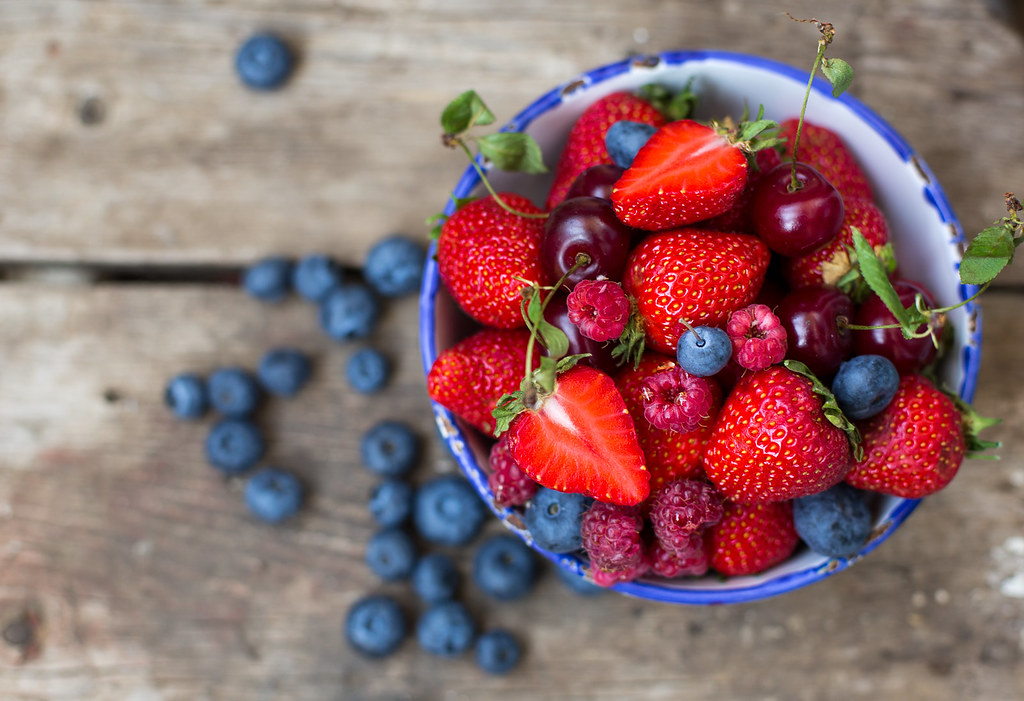
Studies show that eating blueberries can improve your ability to concentrate and perform tasks requiring you to really focus. Scientists still don’t know why they’re beneficial. Some believe that it may be their high antioxidant content which helps vacuum up potentially damaging free radicals. Others suggest it’s their ability to reduce inflammation and increase the flow of blood and oxygen to your brain. Whatever it is, blueberries are a tasty, brain friendly food. I find that my energy stays consistent for several hours after eating them, especially when added to a protein shake or plain yogurt.
How much should you eat? You eat 1 cup a day. Eat them alone or add them to a protein shake for a delicious snack. Avoid eating them with sugar-rich desserts the blood sugar spike you'll get may diminish their brain boosting benefits. Don’t expect to see instant brain-boosting benefits. The benefits are more likely to occur over time.
Dark Chocolate
This will probably be your favorite brain boosting food. Chocolate, especially the dark stuff contains compounds called flavonols that can help improve mental focus. Studies show that drinking flavanol rich cocoa helps increase blood flow to your brain which, in turn, improves your ability to concentrate. A single square of dark chocolate also contains a small amount of caffeine too which also improves mental energy and focus.
Eat 2-3 squares of dark chocolate a day. The darker the chocolate the better.
Eggs
The simple egg is an awesome food for boosting your ability to focus. That’s why I eat them several times a week. I really notice a difference in my productivity after eating them for breakfast, lunch, or dinner.
Each serving of eggs are rich in protein, B vitamins, and choline. Each plays a key role in keeping your brain healthy. The choline in eggs is especially important since it's a component in the cells of your brain. It's also used to make acetylcholine, a compound that helps your brain send messages from one cell to another.
Eat eggs 3-4 days a week for the best results. You shouldn’t worry about their cholesterol content either. Studies show that it’s not bad for your heart. Don’t throw away the yolks as this it the part of the egg where the B vitamins, choline, and other brain healthy nutrients are contained.
Fatty Fish
Once I started eating fatty fish and taking a fish oil supplement daily I noticed that I was my ADD like tendencies diminished and I was able to get more work done in less time. I feel calmer too. The reason for this are the omega 3 fats found in fish like anchovies, mackerel, salmon, and sardines. One of these omega 3’s, DHA is found in large amounts within our brains. The other, EPA is converted to DHA once it’s been consumed.
EPA and DHA help our brains in a few ways. The first is that they increase the ability of the cells in our brain to communicate with one another. This makes it easier for your brain to properly function. Another is that omega 3 fats increase the production of dopamine and serotonin, two chemicals that have important roles with regard to mental focus. Dopamine helps spur you into action and get you to work while also making it possible for you to focus on the task at hand. Serotonin on the other hand helps to keep you feeling calm and better able to deal with stress which also makes it easier for you to concentrate and get things done.
Strive to eat fish at least 2-3 times a week to receive benefit. You may need to eat it more often or take a fish oil supplement to see significant results. Expect it to take a couple of weeks before you notice significant results.
Nuts And Seeds
Eating certain nuts and seeds can help your focus and brain function. They include: walnuts which are shown to boost serotonin levels so you’re better at handling stress, cashews which are rich in magnesium a mineral that can increase blood flow to your brain, and almonds a seed that is rich in phenylalanine an amino acid that helps produce the focus boosting chemical dopamine. I like to buy them raw and roast them myself. This allows me to come up with my own recipes and is much less expensive than buying a bag of roasted nuts.
Eat a handful of these nuts and seeds daily for the best results. You can eat them alone or add them to your favorite recipes. I like them with roasted fish and mixed in with yogurt.
Steak
A nice, lean cut of steak is is full of other nutrients that are good for your brain. It’s rich in B vitamins which your brain uses for fuel and proper function. Every serving also contains creatine, which your body uses for fuel. You also get a nice dose of the amino acid l-tyrosine which is used to make dopamine which, like I previously wrote, helps your brain stay alert, energized and able to fully focus. Since steak digests slowly, it will keep you full between meals minimizing energy crashes and brain fog too.
How much do you need? You can eat steak as often as you like. Aim for 2-3 servings a week, especially on days you really need to focus. I like to eat it for breakfast with our without eggs and find doing so makes it much easier to focus all morning long. If you eat steak regularly, eat lean cuts like flank, flat iron, filet mignon, and sirloin.
Water
Sure, it’s not as sexy as chocolate or tasty as steak but drinking good old water throughout the day instead of soda and other sweetened drinks is of paramount importance to keeping your brain in working order. As you know, water is required for your body to stay hydrated. This is important to our brains since being even a little dehydrated compromises our brains ability to function properly. This means instead of being able to focus you will instead feel lethargic and short of mental energy. Become dehydrated enough and you will find yourself feeling depressed and really out of sorts.
Most experts recommend drinking 8 glasses of water a day. Depending on your activity levels, you may require more or less for optimal results. Since I work out daily, I need to drink 12 or more glass every day. When I drink less my mental energy really wanes.
Putting It All Together
Now you know several foods to you can eat any time for better focus and mental energy. Give these suggestions a try for a month and I guarantee that you will find that you’re able to get more done in less time.
Comment below what you think of the article. Did you find it helpful? Will you start eating more of these foods to help you focus? Let me know :)

Source
http://www.pickthebrain.com/blog/foods-for-mental-energy-and-focus/

Healthy Foods for Mental Energy

Eating a healthy diet can boost your energy levels—both physically and mentally. Getting the extra energy to head to the gym as you are trying to lose weight is great, but a lot of people are surprised by the increased mental clarity and boost to productivity that their healthy diet provides them. Unhealthy foods have the ability to hurt our focus and leave us feeling mentally sluggish and tired.


You can boost mental energy to stay focused and energized for making healthy decisions all day long by adding mentally stimulating foods to your diet.
Here are a few brain-boosting health foods:
  • Almonds and walnuts are just a few nuts that can give your brain a healthy mental boost. Almonds are rich in the amino acid phenylalanine that helps the body produce the focus-boosting chemical dopamine. Try eating a tiny handful of plain, raw almonds when you need a mental refresher. Almonds also contain a decent amount of protein so they function as a healthy snack that helps keep you full. Walnuts help to boost serotonin levels to help you fight off stress and stay focused on the important matters at hand.

  • Blueberries have long been touted for their many health benefits, and now studies show that eating blueberries can improve your ability to concentrate and perform tasks requiring a lot of mental focus. One theory suggests that their brain-boosting capacities come from their ability to reduce inflammation, which increases the flow of oxygen and blood to your brain. You can eat blueberries by themselves or add them to a healthy protein shake for added weight loss benefits.
  • Fatty fishes contain healthy omega-3s which help the cells in our brain communicate efficiently with one another, thus enhancing cognitive function. Also, consuming omega-3s from healthy fish increases the body’s production of dopamine and serotonin—two chemicals known to enhance mental focus.
Though water isn’t necessarily a food, it’s highly capable of restoring energy levels within the body. If your body doesn’t receive enough water it can become dehydrated, potentially causing you to feel lethargic and unable to concentrate. Try to drink at least 64 ounces of water every day—more if you are engaging in strenuous exercise. 

These are just a few healthy foods that you can add to your weight loss diet to help you stay energized. As with any new additions to your diet, make sure you speak with your weight loss doctor before changing your diet plan.


Source
http://www.delightmedical.com/wellness-blog/healthy-foods-for-mental-energy

Sunday, 25 October 2015

Trigger Foods: Foods That Make You Do Bad Things

Certain gateway or trigger foods open the floodgates to unhealthy eating habits. Outsmart the sneaky culprits that derail your diet

It's a common slipup: After weeks of eating well, hitting the gym, and skipping dessert, you're on track to lose those five pounds. You deserve a reward—some candy, a (non-diet) soda, or a side of fries. But hours later, the scene around you looks like The Hangover meets the Food Network.
In the same way that some drugs pave the way for even harder ones, a weakness for a certain foods can open the door to an avalanche of bad eating choices, says Gary Wenk, Ph.D., author of Your Brain on Food. Some foods are like gateway drugs," he says. "From your brain's viewpoint, there is no difference." These so-called gateway or trigger foods make you feel out of control, maybe even physically unable to stop reaching for more, in part because of their addictive effect on your mind and body, according to research. But rehab is probably easier than you think.

Junk Food Junkies
It may seem silly to think about being addicted to food, something we'd die without, but most of us eat for a lot more than just survival. Merely looking at or thinking about a food you know you love activates the reward portion of your brain, the nucleus accumbens—the same area stimulated by drugs and alcohol. This triggers the release of dopamine, a feel-good chemical that enhances your awareness of that food (so forget ignoring it!).
And once you've taken that first bite, watch out. Tasting food engages all of your senses (and may be felt more intensely in women than in men, for unknown reasons). Your nervous system responds by secreting insulin (which drops blood glucose) and relaxing your stomach muscles, which makes you feel like you need to eat more to be satisfied, says Susan Roberts, Ph.D., a professor of nutrition at Tufts University and coauthor of The "I" Diet.
There's a reason this tends to happen almost exclusively with fatty and sugary foods and not, say, lettuce. The saturated fats in foods like bacon and cheese impair your brain's normal ability to regulate appetite and cravings, so you don't realize you're full until you're completely stuffed, says Kelly McGonigal, Ph.D., a health psychologist at Stanford University and author of The Willpower Instinct. What's more, that effect on your appetite can last for up to three days, the length of time it takes to flush those fats from your system. So one unhealthy indulgence can end up triggering a major relapse.
Add sugar to the fatty food—ice cream, cake, doughnuts—and you have a double whammy. High-sugar foods increase your levels of ghrelin, a hormone that stimulates appetite and increases cravings. "So you may tell yourself 'Just one bite' but find yourself wanting more and more, the more you eat," says McGonigal.
Sugar also has been shown to enhance memory storage, which may explain why you want it in the first place, and so much of it on special social occasions. As a result, your brain has evolved a system of rewards that gives you a real high when you eat sugar. "The brain responds to both sugar and fat by releasing endorphins," says Wenk. Chemically, those feel-good compounds are similar to morphine and can have a biological impact similar to a shot of heroin—including causing you to jones for another fix when the initial euphoria begins to fade.

Regaining Control
Avoiding cravings entirely is tough, given that they can be brought on by stress, PMS, or even just thinking about eating. But there's plenty you can do to avoid skidding down the slippery slope of gateway foods.

Use Your Head
One of the best times to stop a binge is before it begins.
A 2010 study by Australian researchers found that thinking about a craving uses up mental energy—enough that you'll struggle to do anything else or even think normally. But if your brain is otherwise engaged, you'll have fewer cognitive resources available to conjure up mental images of brownies. So when a craving hits, try doing long division, sudoku, or counting backward, and see if it goes away.

Interrupt Yourself
If you're three bites into a pint of fudge ripple when you feel a pang of regret, try switching to a healthier snack. Once your senses have been engaged, your body is going to demand more food, but you can still decide what to give it. Sorbet or a piece of fruit can freshen up your palate, which can help put the brakes on thinking about the stuff you crave.

Hide Your Triggers
Proximity to food influences how much of it you eat, says James Painter, R.D., a professor at Eastern Illinois University who studies behavioral eating. Try keeping healthy foods right where you can see them, and stash unhealthy ones in a hard-to-reach drawer—or just don't keep them around at all.

Get Back On Track
Maybe you couldn't stop yourself from polishing off the entire caramel sundae, but that's no reason to give up entirely. We have a tendency to focus on the short-term consequences of our actions, but keeping a long-term goal in mind—say, fitting into that really cute bikini—can help you realize that you can still get there despite a setback, says McGonigal. Think of it this way: Every meal is a chance to start over and do it right.


Source
http://www.womenshealthmag.com/food/foods-to-avoid

Saturday, 10 October 2015

The Truth About Sugar Addiction

Sugar Detox: Hype or Hope?

A trendy sugar detox diet promises to end your craving for sweets and help you lose weight. But does it work? Here's the truth about sugar cravings and how to tame your sweet tooth.


Can You Really Be Hooked on Sugar?

Some people use sugary foods in ways that aren't healthy, even though it may not be an actual addiction. Some signs: You crave sugar, lose control, and eat more than you planned.

Your Brain on Sugar

Sugar fuels every cell in the brain. Your brain also sees sugar as a reward, which makes you keep wanting more of it. If you often eat a lot of sugar, you're reinforcing that reward, which can make it tough to break the habit.

Quick Sugar Highs ...

Why do you get a rush when you eat a midday candy bar? The sugar in it -- called a simple carbohydrate -- is quickly turned into glucose in your bloodstream. Your blood sugar levels spike. Simple carbs are also found in fruits, veggies, and dairy products. But these have fiber and protein that slow the process. Syrup, soda, candy, and table sugar don't.


… And Sugar Lows

Your body needs to move glucose out of the bloodstream and into your cells for energy. To do this, your pancreas makes insulin, a hormone. As a result, your blood sugar level may have a sudden drop. This rapid change in blood sugar leaves you feeling wiped out and shaky and searching for more sweets to regain that sugar "high." So that midday candy bar has set you up for more bad eating.

Starch Can Equal Sugar

Think you don't have a sweet tooth, but crave bagels, chips, or french fries? These starchy foods are complex carbs that the body breaks down into simple sugars. Eaten without better foods, starches can make blood sugar surge and crash like sugar. White rice, white flour, and potatoes do this. Highly refined starches like white bread, pretzels, crackers, and pasta are worst.

Do Sugar Detox Diets Work?

Can you beat your sugar habit by quitting cold turkey? Some sugar detox plans urge you to avoid all sweets. That means all fruit, dairy, and refined grains. The idea is to purge your system of sugar. Diet changes like this are too drastic to keep up. Changes that you can do only for the short term mean you'll fall back to your old habits.

Retrain Your Taste Buds

You don't need sugar as much as you think you do. In fact, you can train your taste buds to enjoy things that aren't as sweet. Try cutting out one sweet food from your diet each week. For example, pass on dessert after dinner. Start putting less sugar in your coffee or cereal. Over time, you will lose your need for that sugar taste.


Choose Good-for-You Sweets

You don't have to give up sweetness. Just get it from other sources. Try fresh berries or pureed fruit on oatmeal instead of sugar. Explore fruit that's dried, frozen, or canned (without too much added sugar). A glass of low-fat milk or low-sugar yogurt can help.


Kick the Habit in Baby Steps

If you make small, simple changes to your diet, it's easy to keep them up. Start by eating more fruits and vegetables. Drink extra water. Check food labels, and pick those that don't have a lot of sugar. Cut out a little bit of sugar each week. After a few weeks, you'll be surprised at how little you miss it.


Let Protein Help

Eating protein is an easy way to curb sugar cravings. High-protein foods digest more slowly, keeping you feeling full for longer. Protein doesn't make your blood sugar spike the way refined carbs and sugars do. Pick proteins like lean chicken, low-fat yogurt, eggs, nuts, or beans.


Fill Up on Fiber

Fiber helps fight a sugar itch in many ways. First, it keeps you full. High-fiber foods also give you more energy. Because they don't raise your blood sugar, there's no hungry crash after. Choose fruits, vegetables, and whole grains. Or smear some peanut butter on an apple for a protein/fiber combo.


Get Outside

Exercise can help wipe out those sugar cravings and change the way you eat in general. You start to feel better and want healthier foods. Do what you like, such as walking, riding your bike, or swimming. Start out slow, and work toward at least 30 minutes at a time, 5 days a week.


Can Artificial Sweeteners Help?

Some studies suggest artificial sweeteners may leave you craving more sugar. That could make it harder to control your weight. The problem is, some experts say, that artificial sweeteners don't help you break your taste for sweets. Pay attention to your body. Are sweeteners making you crave even more sugar? If so, look elsewhere for that sweet taste.


Limit the 'Healthy' Sugars, Too

Honey, brown sugar, and cane juice may sound healthy. But sugar is sugar. Whether it comes from bees or sugar cane, it can cause your blood sugar to rise. Honey and unrefined sugars are slightly higher in nutrients, but their calories still count.


How Much Sugar Is Too Much?

If you're like most people in the U.S., you eat 19 teaspoons or more of added sugar a day. That adds up to 285 calories, which health experts say is way too much. How much sugar should you be eating? No more than 6 teaspoons daily for women. That's 100 calories. Men should get a max of 9 teaspoons. That's 150 calories.


Sugar by Any Other Name

You don't always see the word "sugar" on a food label. It sometimes goes by another name, like these:
  • Agave nectar
  • Brown rice syrup
  • High-fructose corn syrup
  • Dextrose
  • Evaporated cane juice
  • Glucose
  • Lactose
  • Malt syrup
  • Molasses
  • Sucrose
Watch out for items that list any form of sugar in the first few ingredients, or have more than 4 total grams of sugar.


Scout Out Hidden Sugar

Sugar can hide in foods where you least expect it. Although they don't seem sweet, ketchup, barbecue sauce, and pasta sauce can have loads of sugar. So can reduced-fat salad dressings, bread, baked beans, and some flavored coffees. Get in the habit of reading labels. Filter out high-sugar foods before they hit your shopping cart.


Does Sugar Cause Diabetes?

Sugar itself doesn't cause diabetes. But lots of sugar splurges can point you there. Too much of anything, including sugar, can pack on pounds, for one thing. Heavy bodies have a harder time using insulin, the hormone that controls blood sugar. When your body resists insulin, blood sugar and your risk of diabetes go up.


How much sugar is in your diet? Do you indulge a little too much? What strategies do you implement to help divert you from snacking on sugary, high-cal foods? Comment below!


Source
http://www.webmd.com/diet/ss/slideshow-sugar-addiction
Reviewed by Michael W. Smith, MD on /2, 14 1

Wednesday, 30 September 2015

This Diet Can Lead To Weight Loss, Sharpen Your Brain, And Extend Your Life. But Do You Actually Want To Do It?

I'm sitting in front of a bowl of cauliflower (five florets, to be exact) drizzled with Sriracha sauce. Ordinarily, this would barely qualify as a snack. Today, it's lunch. I'm not sure which organ is more outraged: my grumbling stomach or my sandwich-starved brain. But my stomach is definitely louder.
At 52, I'm just a handful of pounds overweight—but that handful is spilling blatantly over the top of my jeans. I need to find a way to rein in my appetite, or just invest in a wardrobe of chic, oversize tunics—a slippery slope at this age. (Next up, muumuus?) My search for a healthy long-term solution has led me to today's paltry meal. I'm trying intermittent fasting and eating more like our prehistoric ancestors—the world's oldest new diet.
You've probably heard about this before. It's spawned a documentary, dozens of books (including a New York Times best seller), and a frenzy among scientists. The National Institutes of Health is funding and conducting several studies to determine how and why it works. With a fan base that consists of everyone from ripped CrossFitters to nerdy scientists, it's enough to make even a diet skeptic like me curious to try it.


The concept of intermittent fasting is simple: Alternate days of eating normally with modified fasting days on which you eat just 500 calories—and watch the pounds drop off. The reality is a bit more daunting. Will I be able to subsist every other day on the same number of calories that a miniature poodle does?
The research on intermittent fasting—along with the stories of people who've tried it and swear by it—helps diminish my doubts. Many of the first studies were led by Krista Varady, a nutritional scientist at the University of Illinois, who is surprisingly animated and engaging for someone who spent her early career in a lab putting rodents on diets. Over the past decade, she has looked at more than 600 people in eight clinical trials of alternate-day fasting, and she's found that obese people reliably lose weight at a very safe rate—about 2 to 3 pounds a week. Equally promising, Varady discovered that measures of cholesterol, triglycerides, inflammation, and blood sugar improve when people fast on alternate days. The results were so impressive that a health publisher called her and convinced her to compile her team's voluminous research into a book, The Every Other Day Diet.
One of the reasons periodic fasting works so well is because it's particularly helpful in burning fat. Your body typically chews through its glucose—or sugar—stores in 10-ish hours; once the glucose in your liver is depleted, your hungry tissue is forced to utilize fat for fuel, Varady says. The upshot: With on-and-off deprivation, you lose over 90% of the weight from fat—a good 15% more than with typical diets—and just 10% from muscle. What's more, since it allows you to hang on to muscle, it doesn't seem to cause the usual diet-related plunge in metabolism.
Varady tells me she hit on the 500-calorie modified-fast approach after reviewing prior research that looked at complete fasting every other day. "People hated it," she says. "They were miserable." But when she allowed mice, and eventually humans, to eat 25% of their usual intake on fast days (that's 500 calories for women and 600 for men), most adjusted within a week or two and, to her surprise, consumed just 10% more than usual on "feast" days, when they were allowed to eat with complete abandon. "It might be because your stomach shrinks or your appetite hormones change," she says. The persistent 2-day net calorie deficit knocks off pounds—13 in 8 weeks in obese people. Those like me who want to shave off those last 5 or 10 tend to lose about half a pound a week.
It's not the speediest way to slim down. But as I dig into the research, I discover a slew of new studies that point to other enticing benefits—like, for instance, living longer. In a study published last February, University of Florida researchers put 19 people on an alternate-day fasting program for 3 weeks, drawing blood before and after the diet. The post diet sample revealed that the participants' cells had begun making more copies of a longevity gene—known as SIRT3—that both helps protect against damaging free radical molecules and improves cells' ability to repair themselves.
Its benefits are similar to those of another well-known longevity diet: long-term calorie restriction. "Fasting seems to place stress on cells and prompt them to shift to self-protection mode," says study author Douglas Bennion.
As I read more new research, I learn that fasting might help my mind, too: In animal studies, scientists at the National Institute on Aging discovered that the diet could boost proteins that strengthen neurons and are crucial for learning and memory and may even protect against Alzheimer's disease. Their studies also suggest the diet produces some of the same positive changes in the cardiovascular system as long-term exercise.
But what finally convinces me is Varady's most recent study. In a trial funded by the NIH, she and colleagues found that intermittent fasting is much more effective than everyday dieting at maintaining weight loss—the toughest trick, as any dieter knows. Unlike almost every other diet in the world, the approach is sustainable.
Hunger schmunger, I'm in.
DAY 1
To my husband Gordon's chagrin, it's Friday, and my paltry food choices are making our social plans nonexistent. I've laid in provisions: almonds, celery, arugula, broccoli, cauliflower, pickles, and Sriracha—the flavorful sauce that I'm hoping will gussy up all that rabbit food. Gordon takes one look and texts a friend to meet him for dinner at the local brewpub. Arrayed on the counter, my day's menu does look...how can I put it? Pitiful. Anxious, I call Varady and ask what I am missing. "Protein," she says before I've even finished the question. "About half your calories on the fast day should come from protein, because it's way more filling than vegetables." She also warns me to be sure to drink 8 to 12 glasses of water every day to curb hunger and prevent dehydration—an actual risk when you're taking in so little fluid through food. I guzzle a tall glass, then dash out to Trader Joe's to pick up eggs and lunch meat—and, all right, a wedge of goat Gouda; it's a high-calorie impulse buy, but a reminder that, as Scarlett O'Hara says, "Tomorrow is another day."
This diet may protect against Alzheimer's disease.
With only 500 calories to consume, I chew slowly, which is more pleasurable, I discover, than snarfing. While the expected rumbles from my coddled stomach, which has never known hunger, are uncomfortable, they aren't so excruciating that I cave in and order a pizza. The protein is satisfying, and the Sriracha-dipped veggies do an admirable job of taking the edge off. A study several years ago found that adding hot red pepper to tomato soup caused people to eat 60 fewer calories at the next meal—probably, the researchers speculated, because the spice acts as a mild appetite suppressant. (Here are 25 delicious things you can do with Sriracha.) 
That said, deprivation isn't fun. As the day progresses, I spend more and more time daydreaming about creme brulee, sushi, caramels—even, improbably, a cheesy Velveeta-and-broccoli casserole my mom made when I was a kid. By the time I crawl into bed at 9:30, my food fantasies are so frenzied I can hardly sleep. Varady says that usually goes away after a week or so, and in a recent study, she found that the fast days actually help people who suffer from heartburn or GI discomfort sleep better.
Here's what I ate on Day 1.
(Thankfully, on Day 2, I was able to eat anything I wanted!)
7:30 AM
Coffee, no cream
10:45 AM
Four almonds 28 calories
1:00 PM
Iced coffee (no cream), hard-boiled egg 75 calories
3:00 PM
Bowl of cauliflower florets dipped in Sriracha 50-ish calories
3:30 PM
Sans usual sugar fix, 20-minute nap
3:50 PM
Bowl of broccoli/Sriracha 50-ish calories 
Small apple 70 calories
4:15 PM
Hike 4 miles
5:30 PM
Famished. Two slices of ham with mustard 45 calories
Cup of peppermint tea
5:45 PM
Two more slices of ham with slender slices of goat Gouda, which I'd vowed not to eat today 125 calories
7:30 PM
Eight almonds 56 calories
7:45 PM
Four almonds 28 calories
DAY 2
I awaken bleary-eyed but a pound lighter—and ready to attack the contents of my fridge. But as I'm sipping my coffee, I notice something odd: I'm not hungry. Eat! I tell myself, feeling slightly frantic. I have no intention of letting my day of heedless consumption slip away. I nibble some blackberries and have a small bowl of Greek yogurt, but my stomach's not interested.
As I learn from Varady, this is what happens—the reason people on the diet lose weight. On the Facebook page for The Every Other Day Diet, I find plenty of people who confirm this phenomenon.
Joanna Grindle, a 45-year-old nurse and mom of three in Vernal, UT, lost 53 pounds in 4 months and has kept it off for a year by fasting just 1 day a week. "The diet completely changed my relationship with food," she says. "Now I stop eating when I'm satisfied instead of stuffed." Same thing for Jennifer Stewart, 54, a Singapura cat breeder in Crookston, MN, who lost 121 pounds, and Aimee Jones, 35, a hotel employee in Lake Elsinore, CA, who tells me she's been doing alternate-day fasting for just a month but has already lost 12 pounds. "I thought I'd want to binge on sweets, but my sugar cravings are going away," she says. "It's a strange feeling." (Get your sugar cravings under control and lose up to 15 pounds with Sugar Smart Express.)
I eat a salad and a tuna melt for lunch, snack on a piece of dark chocolate in the afternoon, and have skirt steak with grilled veggies and risotto for dinner. I want to overindulge, trust me, but I just can't. I feel disappointed—like it's the last day of a trip to the Bahamas when it's rained the whole time.
DAY 3
Although I expect to be ravenous
, I find my second fast day easier. I add new treats—salad with chicken breast, lots of tea ("Warm fluid helps you feel full," promises Varady), bubbly water with lemon. And I save at least 200 calories for right after my 4 pm hike, which triggers a titanic hunger surge. Although I'm still obsessed with the food I can't eat, falling asleep isn't nearly the struggle it was on Day 1.
DAY 4
I'm more prepared for it, but I still feel an odd disappointment at my disinterest in pastries and bacon that mere hours ago sounded irresistible. I'm seeing how little of my usual eating is driven by actual need. As I make my way through another day of alarmingly sensible meals and snacks, it occurs to me that I'm learning the difference between true hunger and boredom-stress-anxiety hunger—and how frequently I engage in the latter.

DAYS 5-10
As my fast-day fantasies decreased
, I gradually lose a pound and a half—and am filled with an odd sense of accomplishment. I can coexist with hunger! The diet is easier than the usual grind of restriction; the 500-calorie limit forces me to plan my meals and leaves me with so few options I don't even think about foods not on the day's menu.
It's not, however, a social diet. I'm cranky having two slices of chicken while my son and husband chow down on steak. Even worse: going to a dinner party and nibbling on crudites as friends ooh and aah over fondue.
Stewart, who has maintained her weight loss for nearly 2 years, says she rearranged fast days to accommodate her social schedule; when she had three back-to-back "feasts," she'd do an equal number of fast days to make up for it. For maintenance, she does 1,000-calorie fast days, keeps an eye on the scale, and throws in a 500-calorie day when the number goes up.
The diet has its detractors. Sara Gottfried, a doctor and author of The Hormone Reset Diet, worries that it can trigger sugar cravings—and binges. Susan Roberts, a professor of nutrition at Tufts University, adds, "It's risky to tell overweight people to eat what they want every other day, because they could actually gain weight. And, in my practice, very few people are interested in trying it. It could wreak havoc on your life. "
No one is certain why, but fasting seems to prevent and reverse obesity.
Varady herself is quick to admit it's not right for everyone. "But for those who hate the constant vigilance of daily calorie restriction, it seems to work well," she says.
My feelings end up somewhere in the middle. Fasting for a day here or there is doable, but every other day for eternity? Not so much. Despite the fact that I've shed weight, the difficulty of planning and monitoring my eating on fast days makes the diet impractical—and I realize, with a pang, that I'm ready to give it up.
But I'd still like to lose a few pounds, so I turn my attention to the studies I've read on a different approach to intermittent fasting: time-restricted eating (TRE). You eat normal amounts every day but cram it all into a 6- to 12-hour time period—it seems to offer many of the same benefits as alternating fast days but is more suited to my lifestyle.
A rebound diet! Just what I need!
TRE isn't nearly as well studied as alternate-day fasting, but it does have promising results. Obese mice have had luck getting ready for bikini season on the program, according to a recent study at the Salk Institute for Biological Studies in La Jolla, CA. In that 38-week trial, rodents that were restricted to eating within a 9- or 12-hour period stayed svelte, while those who consumed the same number of calories throughout the day became obese; more telling, when the obese, eat-anytime mice were switched to the time-restricted approach, they slimmed down. "It seems to prevent and reverse obesity," says Satchidanda Panda, lead scientist of the study. BURTON

No one is certain why that happens, but Courtney Peterson, who is conducting some of the first human trials with her colleagues at Pennington Biomedical Research Center in Baton Rouge, LA, says not eating for so long affects your body's internal clock—and may dictate the robustness of key functions like metabolic rate.
While some scientific evidence for time-restricted eating focuses on 16-hour fasts, there is flexibility in adapting the approach to fit people's lifestyles. Jonathan Stegall, an integrative medicine physician in Atlanta, has seen results in more than 40 of his patients on a 16-hour-fast diet following a monthlong preparation period emphasizing low-carb, organic, and natural foods. Cindy Santa Ana, 45, a mom of two and integrative nutrition health coach in Bristow, VA, lost 50 pounds in the past 2 years by eating only from 10:30 am to 7 pm. "I don't watch my calories, but I eat healthfully—lots of veggies and lean protein and complex carbs like sweet potatoes and carrots," she says. 
I give it a whirl and find that just 1,600 calories leaves me full because it's packed into 8 hours. After a slight hunger pang at 10 pm, I generally fall asleep without being tormented by images of crusty croissants and cheesy omelets. And I'm free to shift my eating window—when we meet friends for dinner at 7, I eat nothing until noon, which isn't that difficult. Though that one heavy, late meal puts half a pound on me, the next day I binge on lemon squares at 2 pm and don't gain an ounce. Either eating earlier in the day is less damaging or I compensated for the cookie binge by eating far fewer calories afterward.
After 8 days of time-restricted eating, I not only have kept off the pound and a half I'd lost but have dropped another two, and my belly is noticeably smaller. I've discovered that I sleep more soundly on a semi-empty stomach and wake up more clearheaded. The diet is the most user-friendly fast around.
Still, I'm not confident I can stick with the strict 8-hour window now that I've reached my goal, so I gravitate to the 12-hour version. Much easier. I use it for 5 weeks and find I both maintain my weight loss and reap fasting's other benefits.
When a friend comments on my newly slender figure, I tell her what I've been up to. "This is the easiest thing I've ever done to lose weight," I say. I mean it.
So from all this, I end up with one rule. Kitchen closes at 7. Turns out I'd rather count minutes than calories.


Source
http://www.prevention.com/weight-loss/facts-about-fasting-diets